
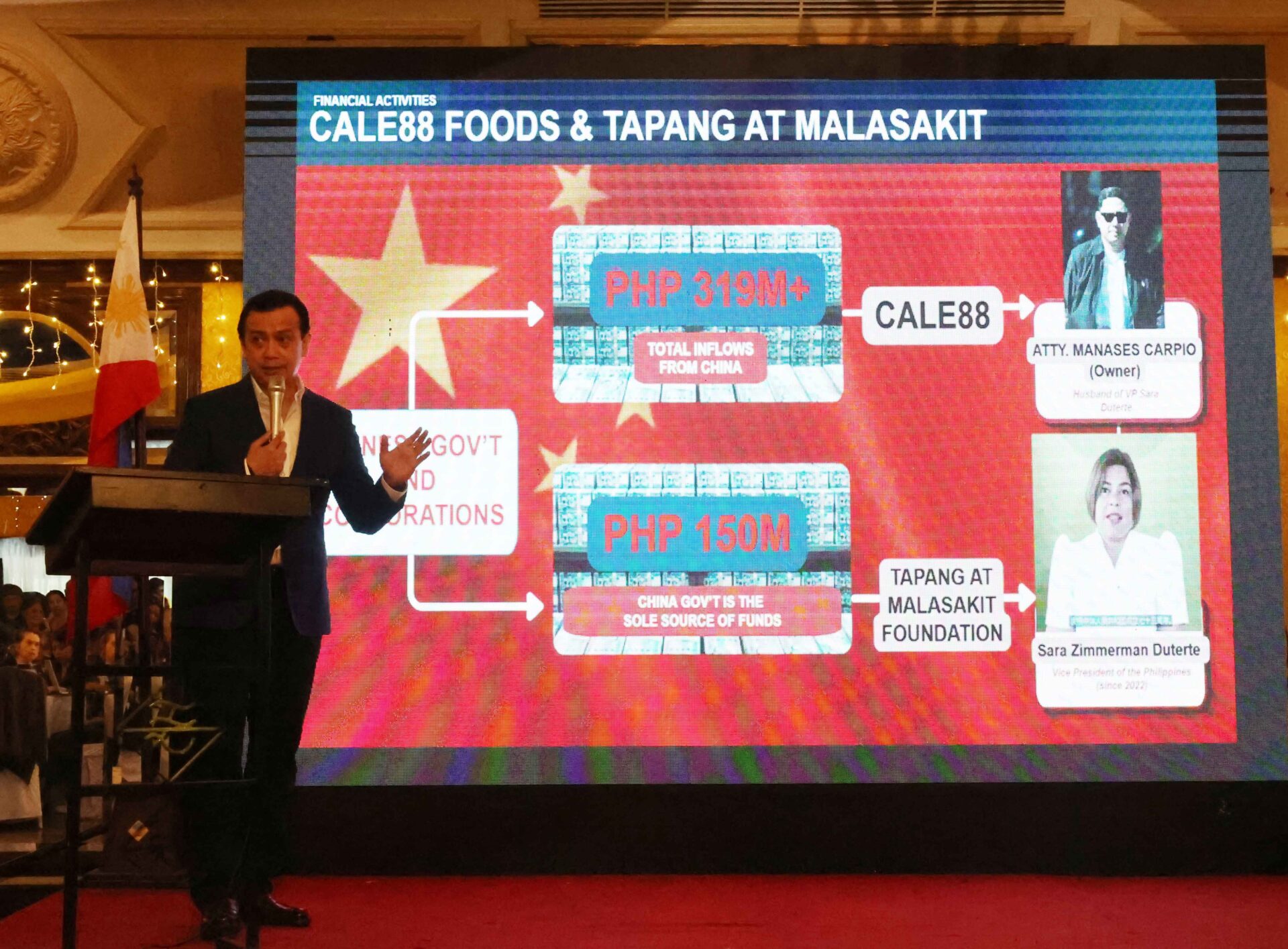
Former senator Antonio Trillanes IV on Friday alleged that a company owned by Manases Carpio, the husband of Vice President Sara Duterte, received more than P319 million from China-linked sources, while members of the Duterte family received millions of pesos in manager’s checks from a man he identified as a Davao drug lord.
Trillanes also alleged that the Tapang at Malasakit Foundation, which he linked to Duterte, received P150 million from the Chinese Embassy, and that the vice president had millions of pesos in bank deposits and investments that were not reflected in her statements of assets, liabilities and net worth (SALNs).
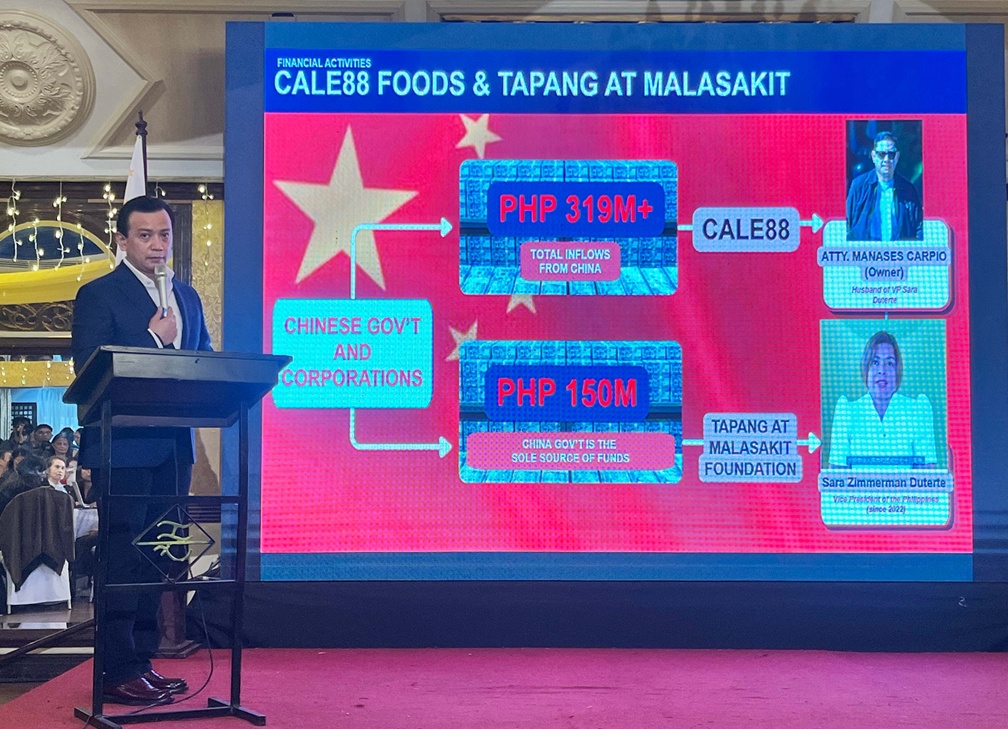
At a press conference in San Juan City on Oct. 2, the former senator presented what he said were bank records, corporate filings and financial disclosures that he had intended to submit as evidence in Duterte’s impeachment trial.
The allegations came a day after the House prosecution panel dropped Trillanes from its witness list, on the 32nd day of the trial, ending the prospect of his presenting the material before the impeachment court.
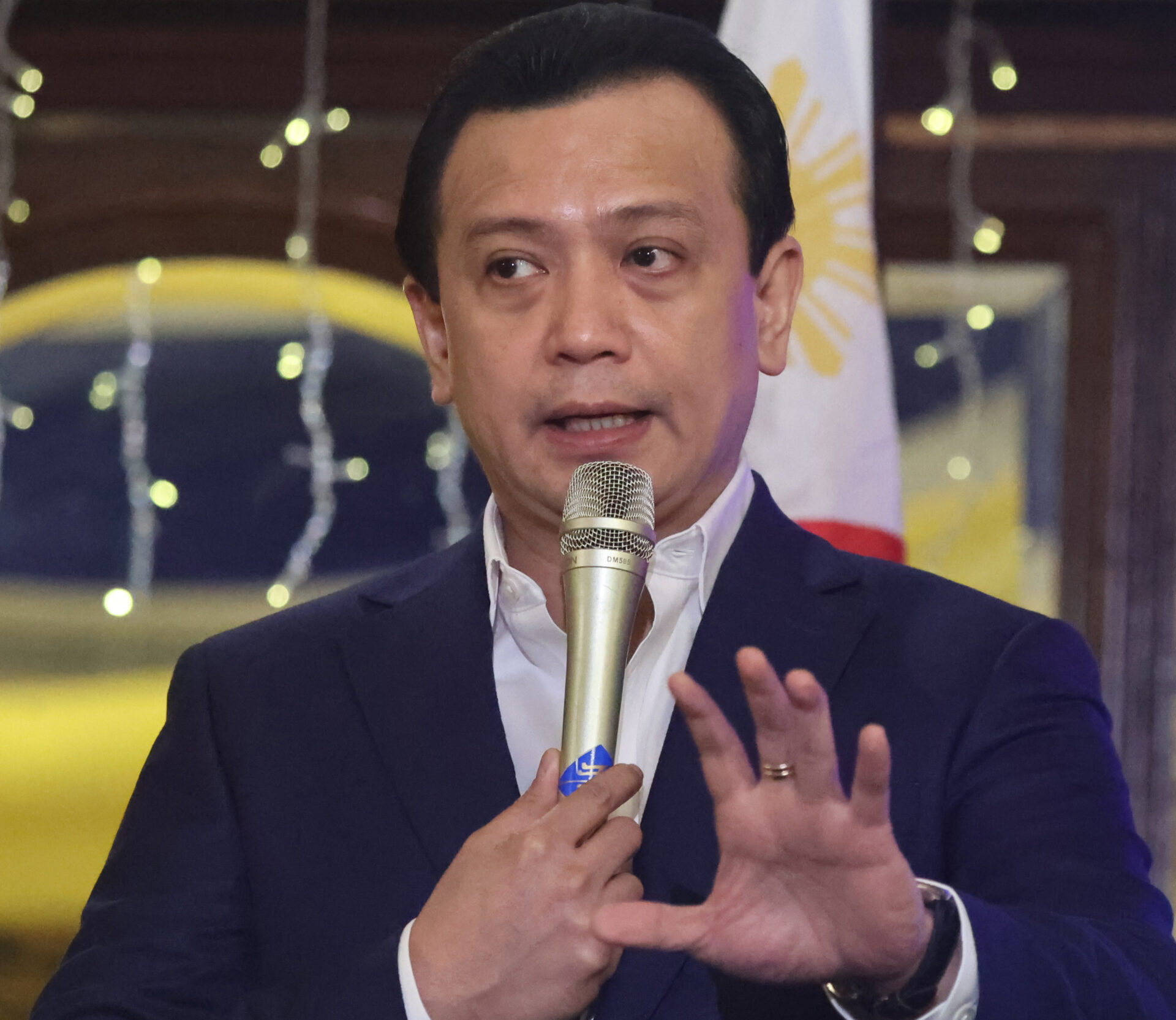
Trillanes described the alleged China-linked transactions as the most significant part of his presentation, saying they raised questions about the sources of funds received by Carpio’s company and the potential national security implications.
“Galing sa Chinese government at mga korporasyon na nakabase at nag-o-operate sa China, pumasok na 319 million pesos, mahigit, papunta doon sa Cale88 na kumpanya ni Mans Carpio, na asawa ni Sara Duterte,” he said.
China-linked transactions
Trillanes alleged that more than P319 million flowed into Cale88 Foods Corp., which he said was owned by Carpio, from the Chinese government and corporations based in China.
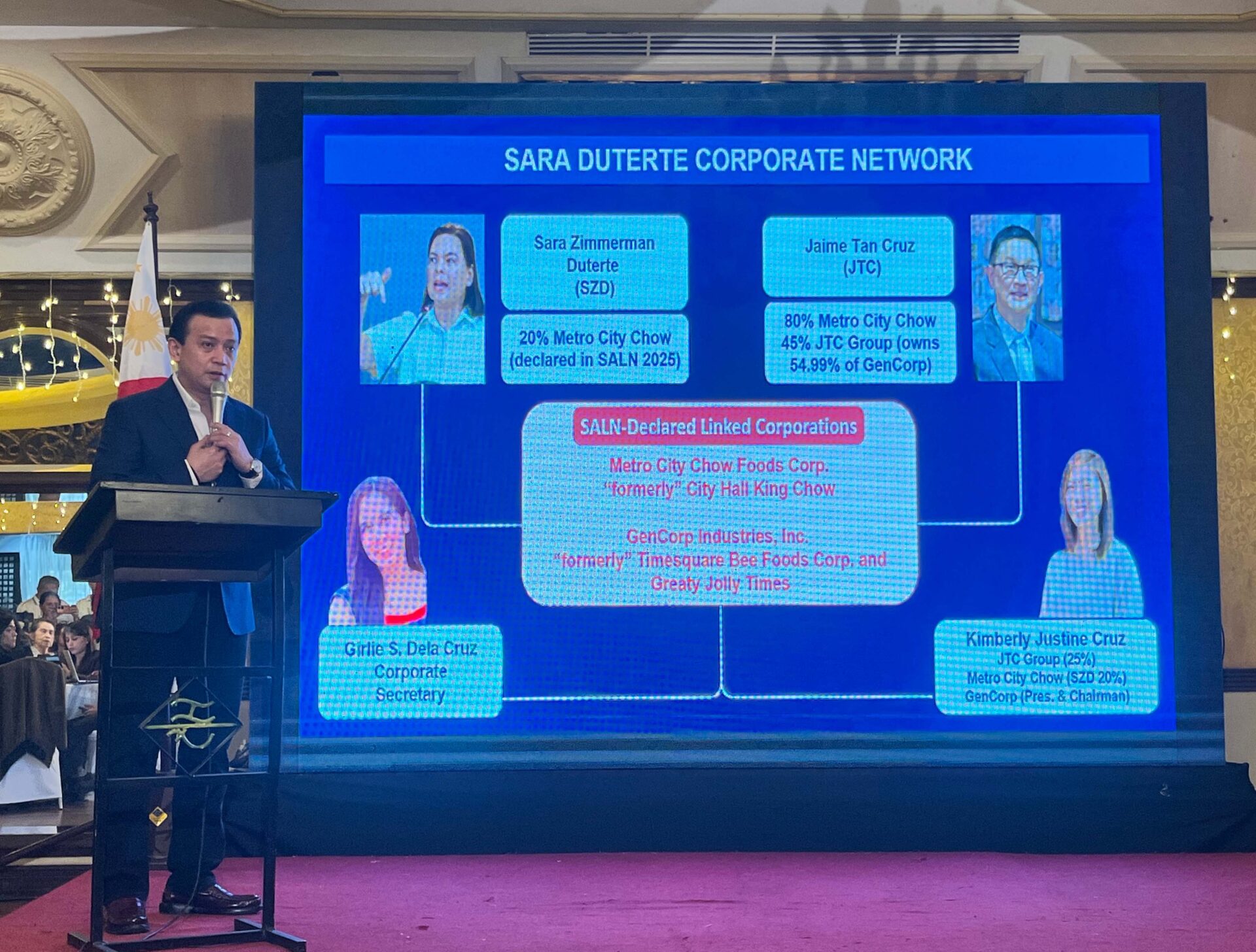
He said the company, incorporated in 2021 with declared paid-up capital of P125,000, presented itself as a banana-chip exporter but had financial and operational figures that he considered questionable.
According to Trillanes, Cale88 reported no sales in 2021 and only P20,000 in 2022, before sales increased to P23 million in 2023 and P150 million in 2024, then declined in 2025.
He also cited a monthly electricity bill of about P8,000, the absence of rank-and-file employees in 2024 and only two in 2025, and the lack of trade receivables and payables.
Trillanes questioned how the company could report P150 million in sales in 2024 while paying only P10,705 in taxes.
“Kahit na sabihin natin, sige, worth 200 million [pesos] na banana chips ang binili. Pero P300 million ang idineposito,” he said.
He added that Carpio divested from the company in 2025, around the time the first impeachment complaint against Duterte was filed, describing the move as a cleanup.
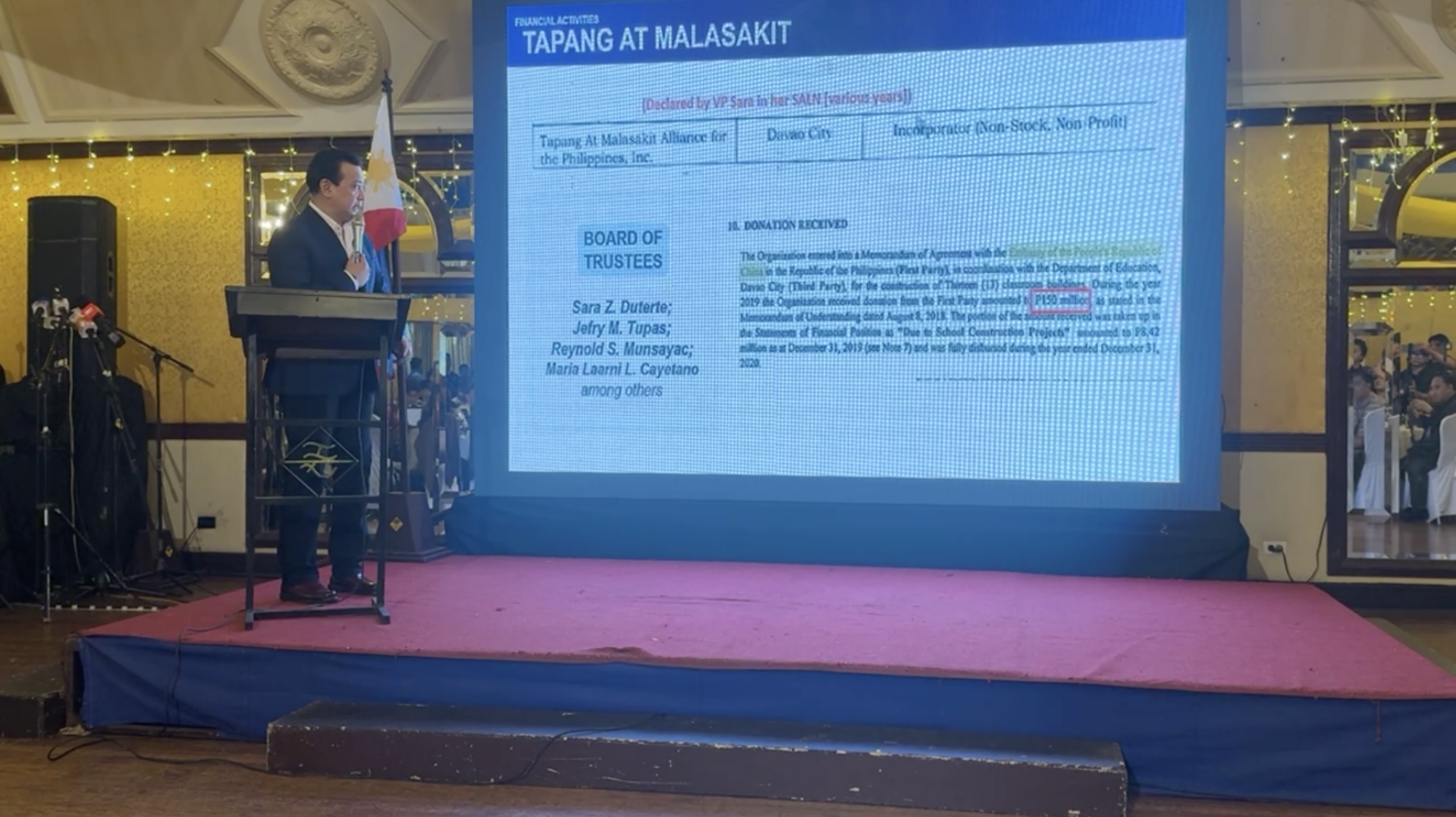
Trillanes also alleged that the Tapang at Malasakit Foundation received P150 million from the Embassy of the People’s Republic of China, with another P450 million deposited into the foundation.
He identified Duterte, her staff member Jeffrey Tupas and Mayor Lani Cayetano as members of the foundation’s board of trustees.
“Ito na ang paraan ng China ng pagsuporta sa mag-asawang Duterte. Maliwanag po ito. Kaya dapat kilabutan po tayo rito. Kasi vice president po siya. May national security implications,” he said.
Trillanes argued that the alleged transactions warranted scrutiny because of Duterte’s position as vice president and the possible implications of accepting funds from a foreign government.
Checks from alleged drug lord
Trillanes also presented what he described as Anti-Money Laundering Council-validated records showing that Sammy Uy, whom he identified as a Davao drug lord and political contributor to the Dutertes, issued manager’s checks to members of the family from 2011 to 2013.
He alleged that Sara Duterte received about P22 million through three checks worth P7.44 million each while serving as Davao City mayor.
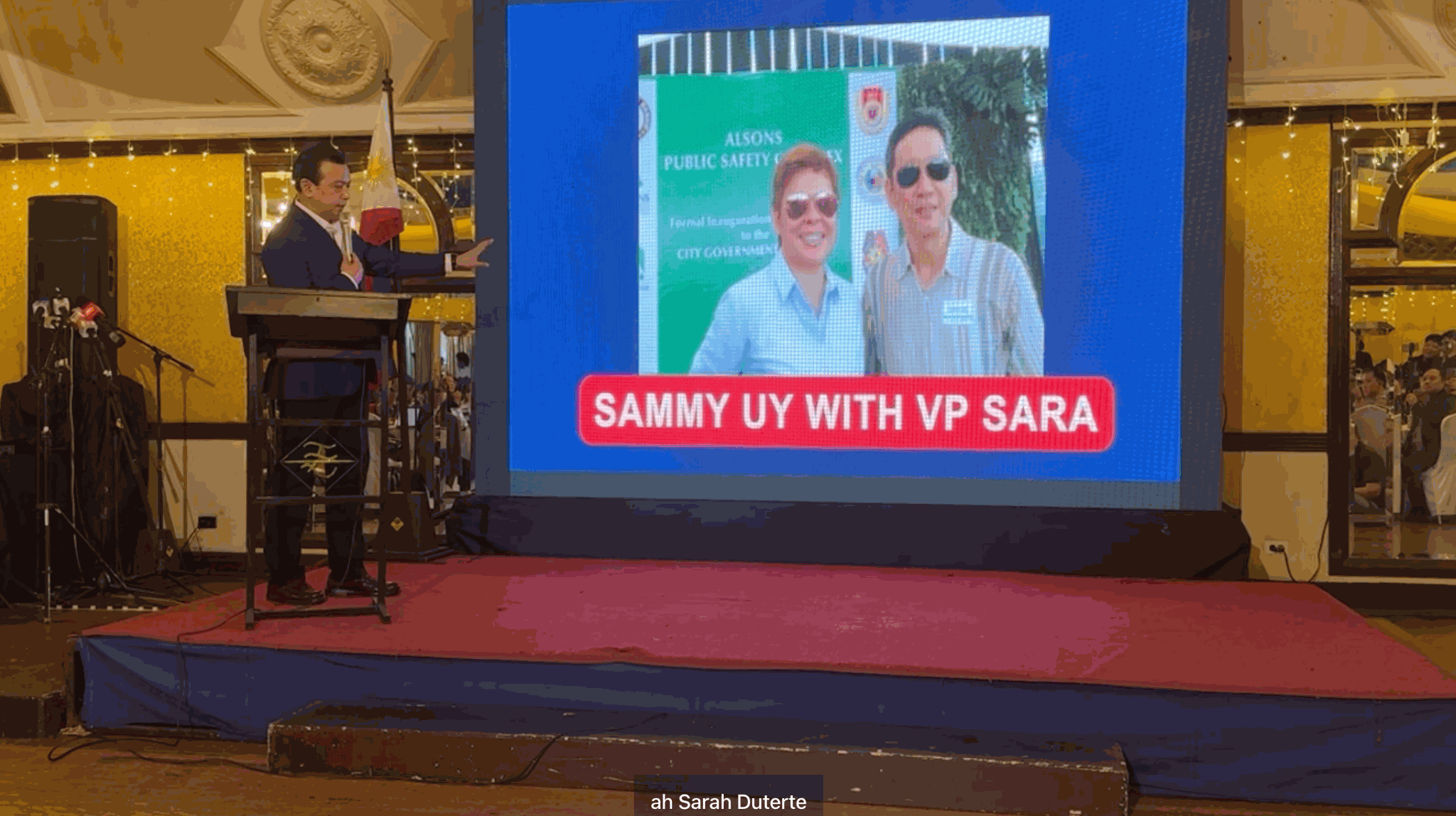
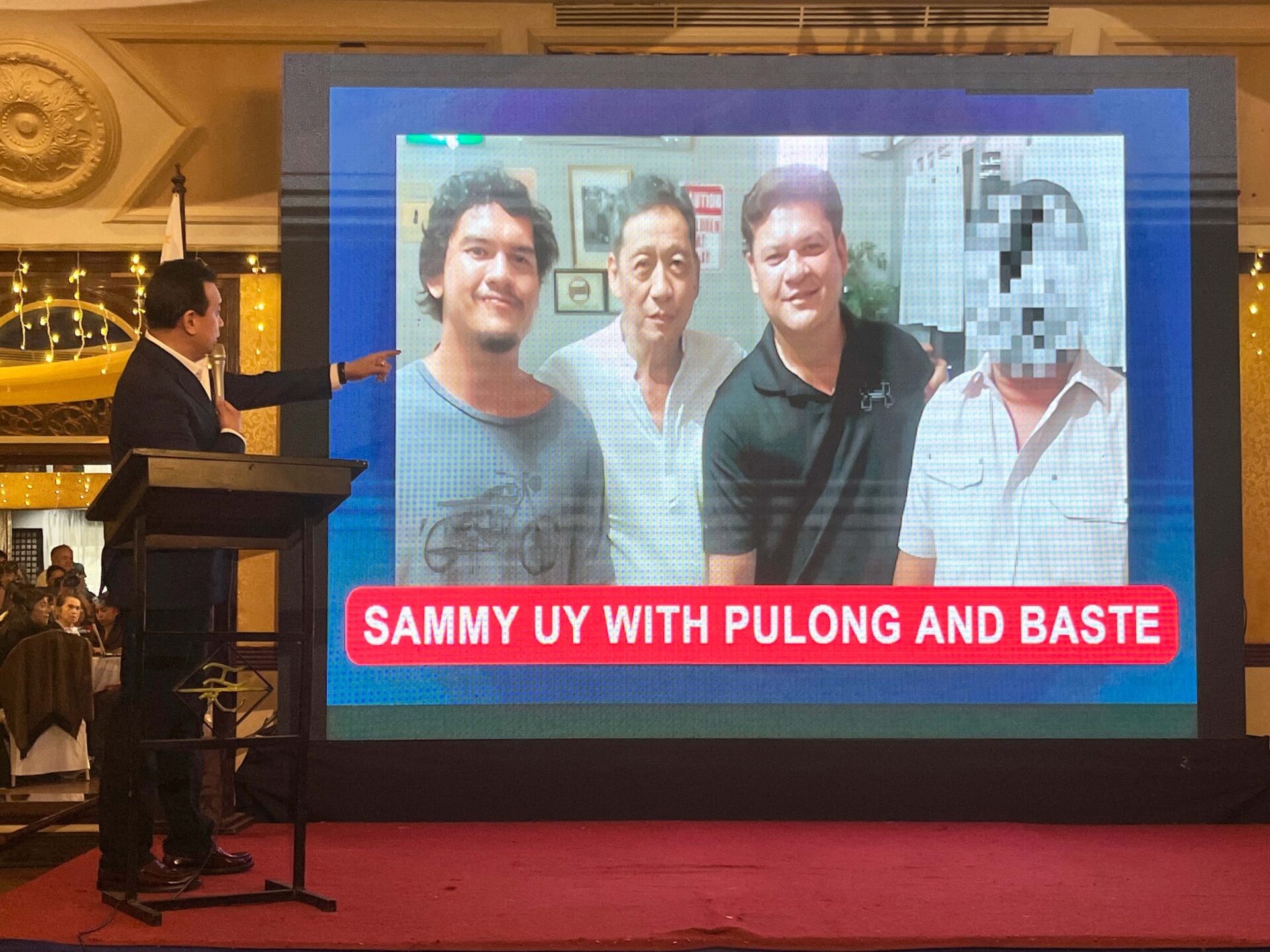
Rep. Paolo Duterte allegedly received P38.8 million through four checks of P9.7 million each, while Davao City Mayor Sebastian “Baste” Duterte received P51.6 million through five checks of P10.3 million each.
Former president Rodrigo Duterte allegedly received about P15.6 million.
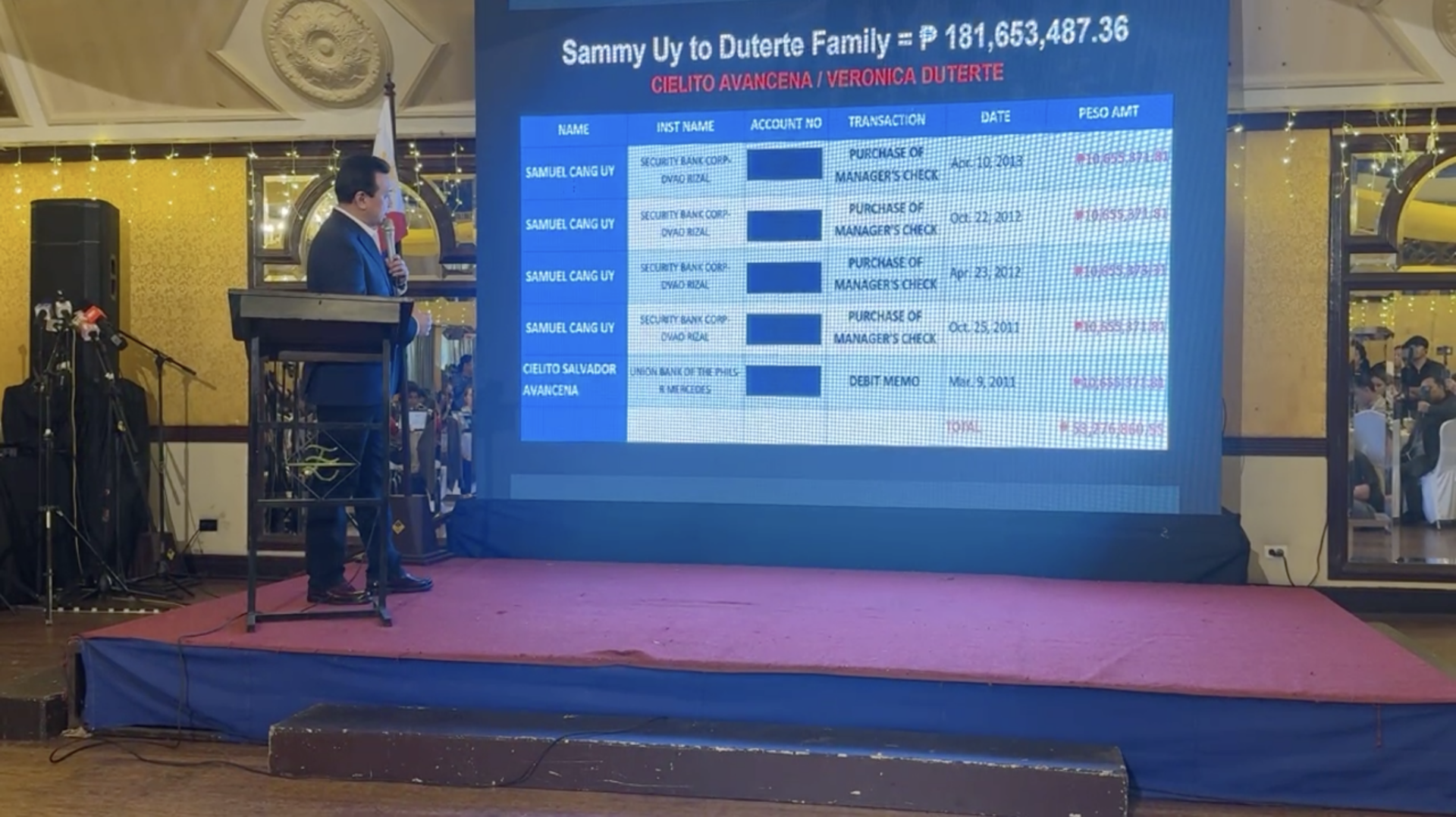
Trillanes further alleged that Veronica “Kitty” Duterte received P53.3 million through five checks worth P10.6 million each. Because she was a minor at the time, he said the checks were issued through her mother, Honeylet Avancena.
“So buong pamilya, bawat miyembro ng pamilya Duterte, tumanggap ng pera mula sa iligal na droga,” Trillanes said.
He described the alleged payments as contradicting Rodrigo Duterte’s public image as a fierce opponent of illegal drugs when he entered national politics.
“When you accept money from illegal drugs, that stain cannot be removed by being elected vice president,” he added.
Deposits, investments questioned
Trillanes also compared bank records he said had been validated by the AMLC with Sara Duterte’s SALNs, alleging substantial discrepancies between her declared assets and her financial transactions.
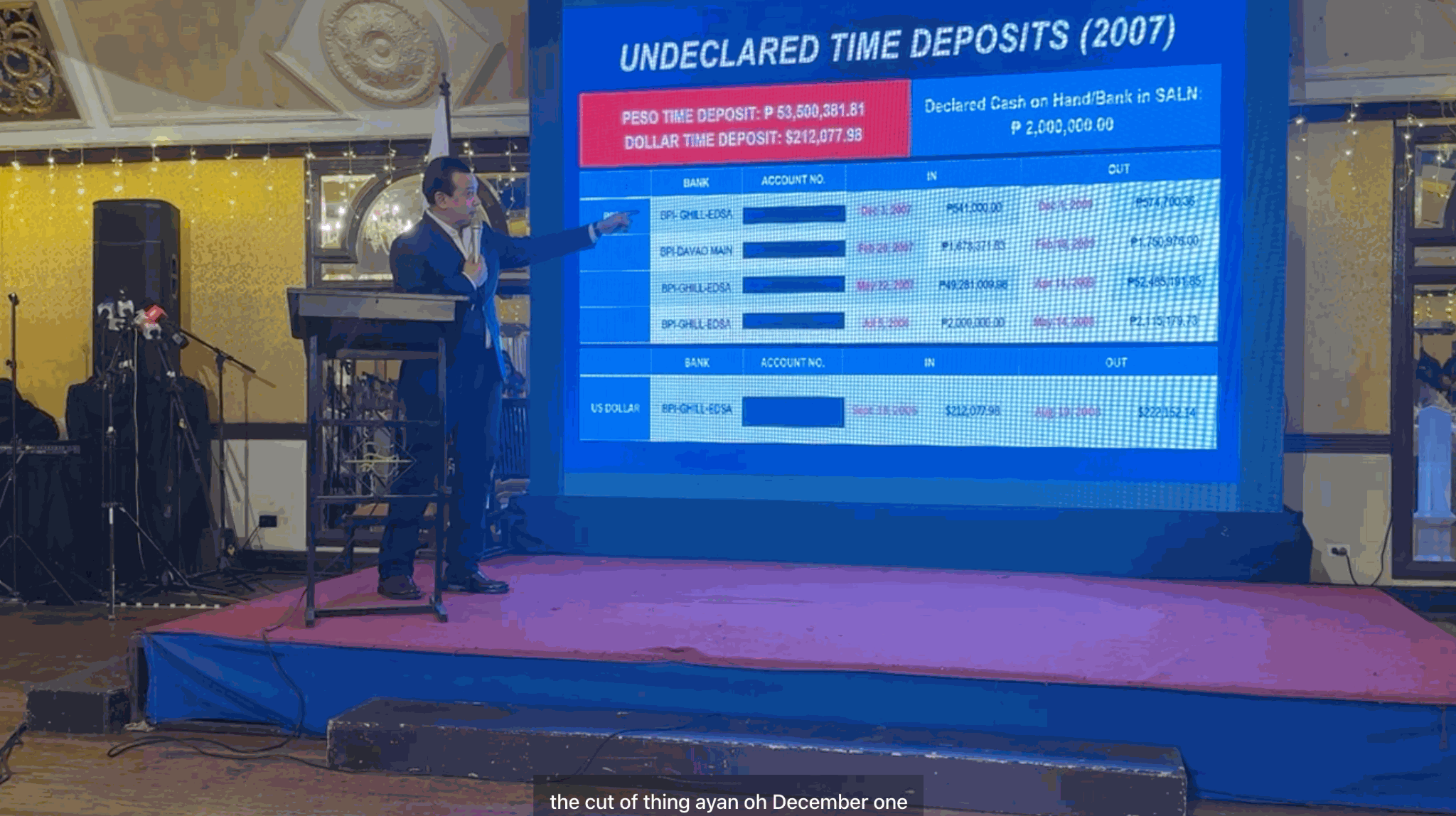
He cited more than P53.5 million in time deposits and $212,000 in 2007, compared with P2 million in declared cash.
For 2009, he alleged that Duterte had a P94.7-million time deposit and $224,000, while declaring P2 million in cash.
He also cited an alleged $1-million investment insurance policy in 2011, when Duterte declared P3.6 million in cash and P2.6 million in investments.
Trillanes argued that the deposits should have been disclosed because the money was deposited before the relevant SALN cut-off dates and withdrawn afterward.
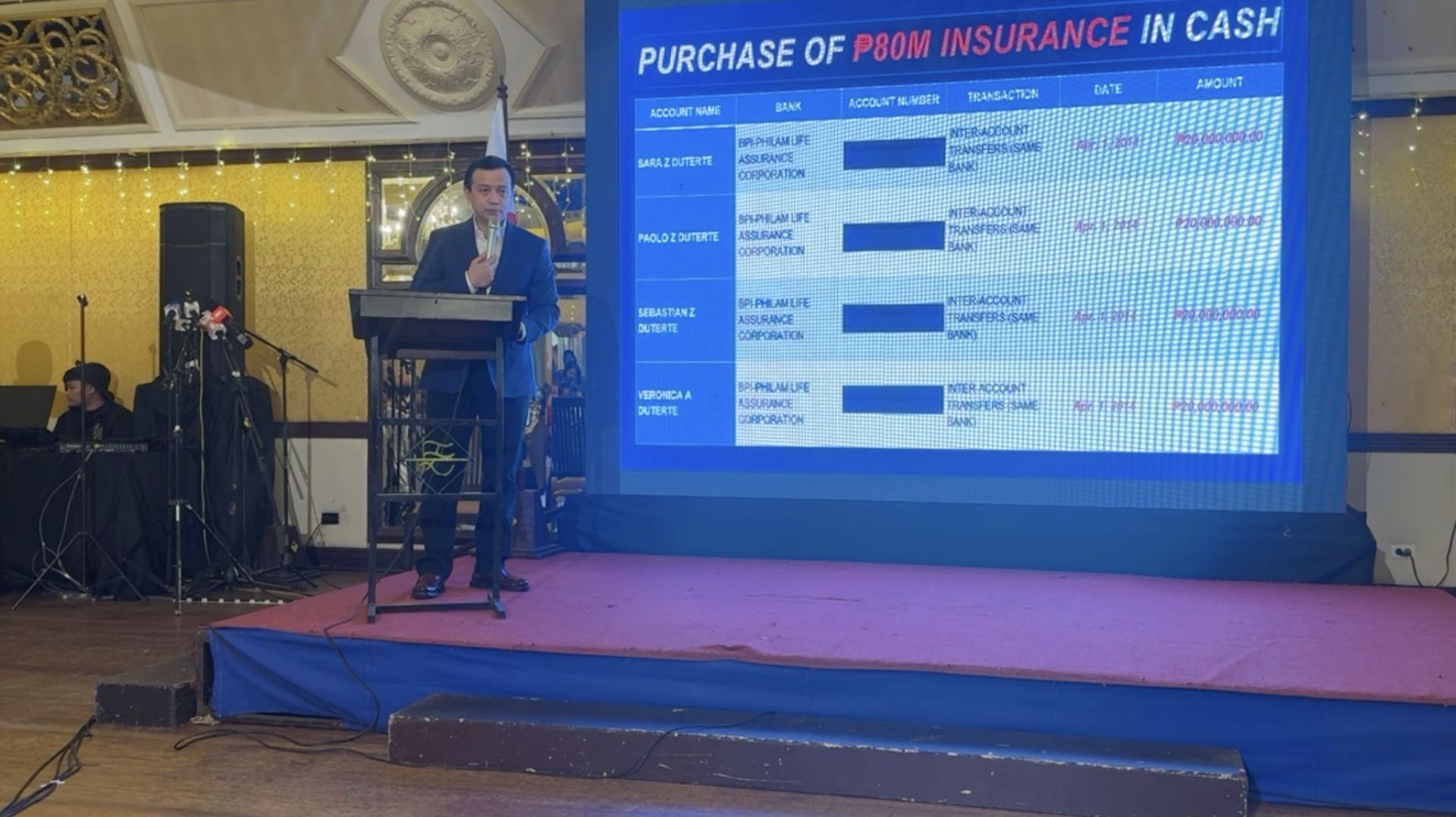
He further alleged that Duterte and her father maintained a joint account from which P96 million was withdrawn in a single day, including P80 million used to pay for an investment insurance policy.
“Bumili si Sara Duterte at Digong ng 80 million pesos worth na insurance. Hindi ito ‘yung insurance na hinuhulugan po ng mga ordinaryong Filipino. Ito, investment insurance ito, isang bagsak ito,” he said.
The allegations, if substantiated, could raise questions about the disclosure of assets, the sources of funds received by companies linked to the vice president’s family, and the financial dealings of public officials.
These also raise questions that would require examination of the underlying bank records, corporate filings, and SALNs, as well as responses from the individuals and entities named by Trillanes.