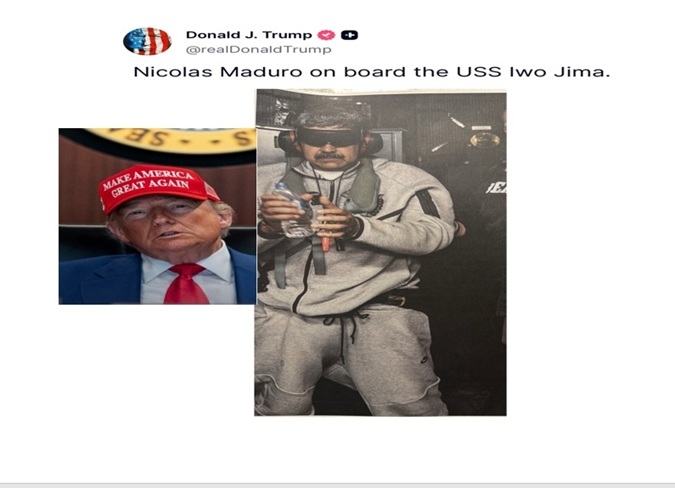

Hours after United States forces invaded Venezuela and captured President Nicolás Maduro and his wife, Cilia Flores, early Saturday (Jan. 3) in an operation codenamed Operation Absolute Resolve, CNN cited sources saying President Donald Trump intends for the United States to “run the country” until a “judicious transition” takes place.
CNN further reported that Washington plans to seize Venezuela’s vast oil reserves, a move that appears to confirm what Maduro has long claimed: that control of oil, not democracy or drugs, is at the heart of Trump’s fixation on Venezuela.
According to the Organization of the Petroleum Exporting Countries, Venezuela holds about 303 billion barrels of oil, roughly one-fifth of the world’s proven reserves, the largest on the planet.
International alarm
The response from the international community was swift. United Nations Secretary-General António Guterres, through spokesperson Stéphane Dujarric, warned that “independently of the situation in Venezuela, these developments constitute a dangerous precedent.”
“He’s deeply concerned that the rules of international law have not been respected,” Dujarric added.
Article 2(4) of the U.N. Charter is unequivocal: All members shall refrain from the threat or use of force against the territorial integrity or political independence of any state.
In Manila, President Ferdinand Marcos Jr. has remained silent (as of this writing, 3 p.m., Jan. 5) though the Department of Foreign Affairs issued a carefully worded statement urging “concerned parties to resolve disputes through peaceful means, and to exercise restraint to prevent escalation of conflict.”
The following day, the DFA updated its statement underscoring the importance of adherence to international law: “The Philippines views with concern the evolving events in Venezuela and their consequential impact on peace and stability in the region as well as on the rules-based international order.
“While acknowledging the United States’ underlying security considerations, the Philippines stresses the relevant principles of international law, including the independence and sovereign equality of states, the peaceful resolution of disputes, the prohibition against the threat or use of force, and non-interference in the domestic affairs of sovereign states.”
Among ASEAN leaders, only Malaysian Prime Minister Anwar Ibrahim issued an unequivocal condemnation.
“The leader of Venezuela and his wife were seized in a United States military operation of unusual scope and nature,” Ibrahim said. “Such actions constitute a clear violation of international law and amount to an unlawful use of force against a sovereign state.”
“It is for the people of Venezuela to determine their own political future,” he added, warning that regime change imposed by external force “will bring more harm than good.”
Trump’s justification, and the facts
Trump has justified the attack by branding Maduro as one of the world’s top drug lords, accusing him of colluding with cartels to flood the United States with fentanyl-laced cocaine.
But this narrative collapses under scrutiny.
A BBC report notes that “Venezuela does not produce large quantities of cocaine — that’s mainly Colombia, Peru and Bolivia.”
Meanwhile, a 2025 report by the U.S. Drug Enforcement Administration says 84% of cocaine seized in the U.S. comes from Colombia, with Venezuela notably absent from its main trafficking routes.
The same report makes clear that fentanyl is largely produced in Mexico, not South America, and enters the U.S. mainly through the southern border.
Why Filipinos should care
Why should Filipinos care about Venezuela, a country more than 100,000 kilometers away?
Filipino human rights lawyer Edre Olalia, president of the International Association of Democratic Lawyers, captured the stakes succinctly. While watching the news early Saturday, he wrote on Facebook: “Offhand, this is not only outrageous but is shameless arrogance that does not appear to have any valid legal basis nor justification. It can only be seen as imperialist aggression and overreach to have global domination and driven by greed over Venezuela’s oil.”
Why would Filipinos care about Maduro who has been widely described as an authoritarian who disrespects human rights?
But international law does not recognize exceptions based on a leader’s character. Every independent and sovereign state, which Venezuela is, has the freedom from external control from other states and has the supreme right to command obedience within its territory.
Dangerous precedent
The Philippine government’s concern should go far beyond the safety of the 74 Filipinos currently in Venezuela, as monitored by the DFA. What matters is the precedent being set.
As Trump and his advisers gloat over what they have done to Venezuela— even floating future targets such as Greenland — the most dangerous consequence is the signal sent to the world: that power, not law, determines legitimacy. Might is right.
As the U.N. secretary-general warned, it sets “a dangerous precedent.”
If the Trump government gets away unsanctioned for the Jan. 3 attack of an independent country and the abduction of a sitting president, despicable he maybe, it would encourage country-bullies to do the same.
What would stop China from forcibly taking over Taiwan, which it considers an integral part of its territory and recognized by many countries under the One-China principle?
An uglier scenario that would directly involve the Philippines should China attack the EDCA sites in Cagayan, which is a shooting distance to Taiwan.
What would prevent Beijing from seizing BRP Sierra Madre at Ayungin Shoal, tightening its grip over the West Philippine Sea?
Notably, China, a close ally of Venezuela, has itself condemned Trump’s action as a “blatant use of force” and a clear violation of international law.
The views in this column are those of the author and do not necessarily reflect the views of VERA Files.