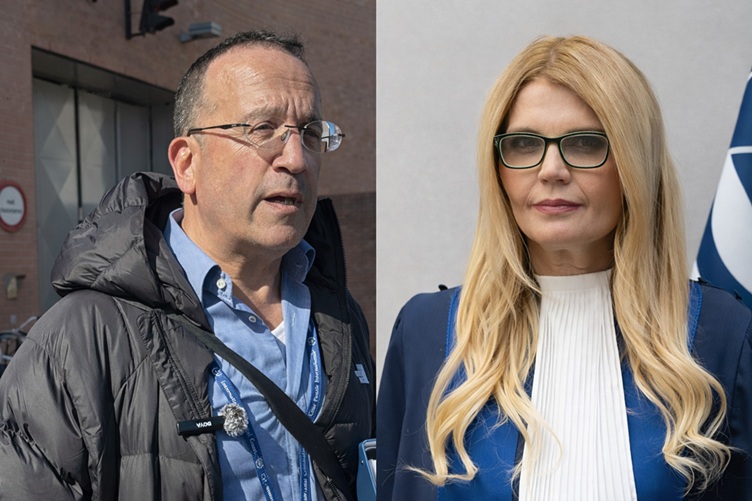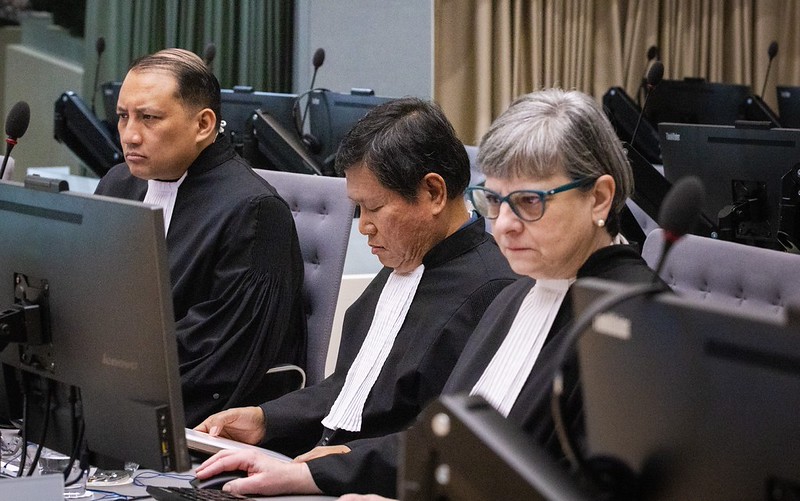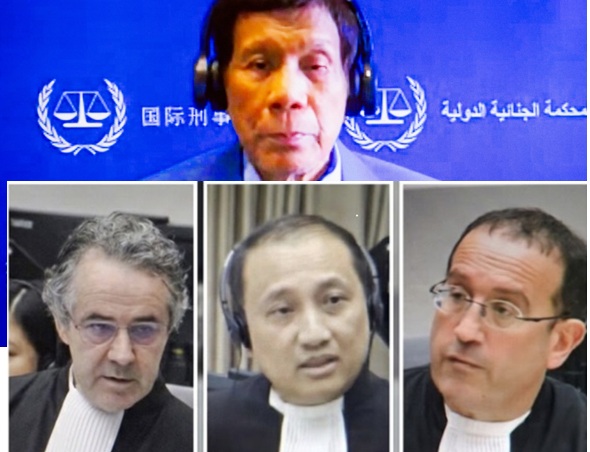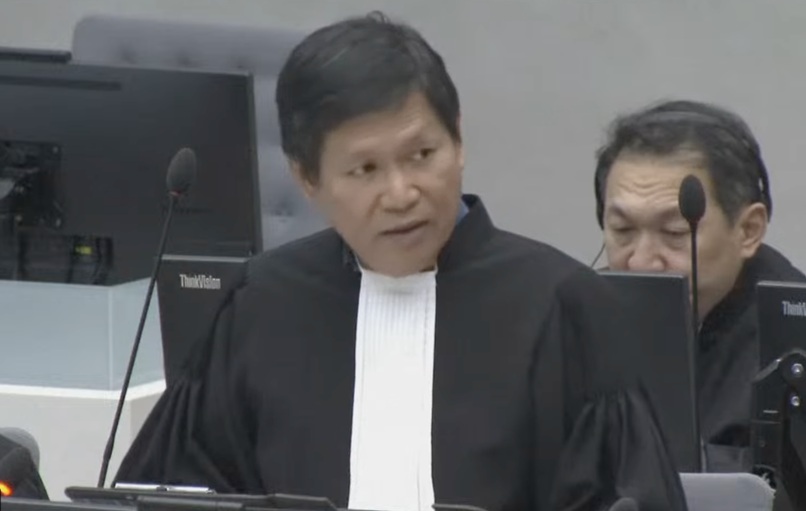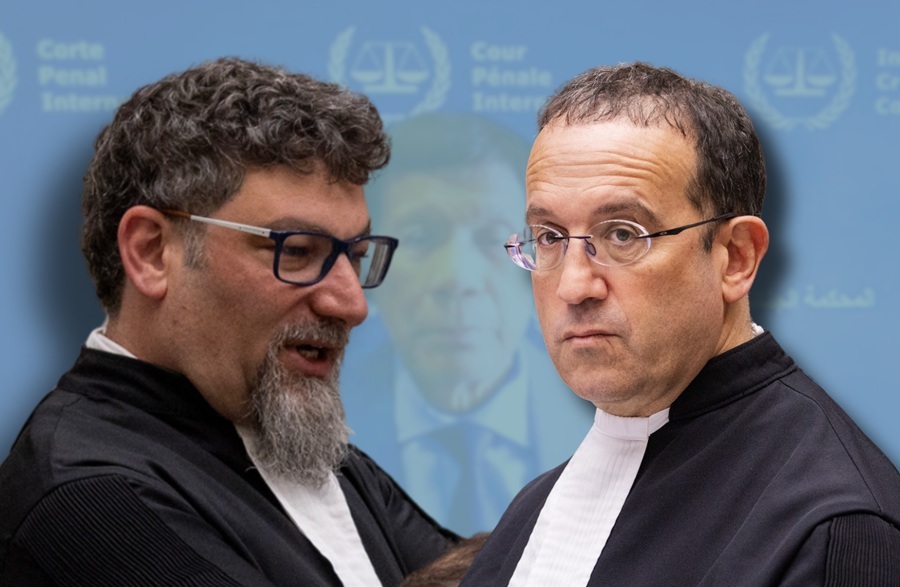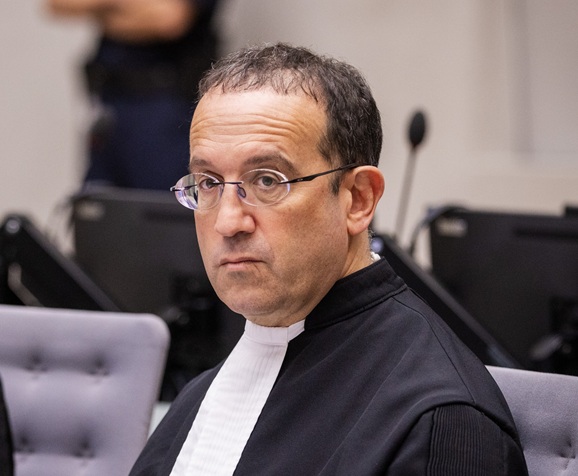

Former president Rodrigo Duterte’s lead defense counsel, Nicholas Kaufman, used sharp language in dismantling the prosecution’s theory, arguing that the International Criminal Court had been presented with “rhetoric in search of causation” rather than proof of crimes against humanity.
On the third day of pre-trial hearings on Feb. 26 at the ICC headquarters in The Hague, Kaufman pressed three central themes: that prosecutors failed to establish a direct causal link between Duterte’s public pronouncements and specific unlawful killings; that there is no “smoking gun” tying him to a criminal plan; and that continued detention would be unjustified absent substantial grounds to believe he committed the crimes charged.
The soon-to-be 81-year-old Duterte is suspected of crimes against humanity of murder and attempted murder allegedly committed between Nov. 1, 2011 and March 16, 2019, spanning his tenure as vice mayor and mayor of Davao City and later as president, while the Philippines was still a state party to the Rome Statute, the treaty that created the ICC.
Last Tuesday, on the second day of the confirmation of charges hearing, prosecutors played video clips and cited transcripts of Duterte’s speeches in which he issued his “kill, kill” orders, promised to shield police from prosecution and assured them they would not go to jail for actions taken in the drug war.
Taking his turn to rebut the prosecution’s assertions, Kaufman said, “It is not enough simply to assert that Rodrigo Duterte said outrageous things, and that deaths occurred, and so, as a result, he must be criminally responsible.”
He emphasized the need for what international criminal law terms a “causal nexus.”
“The prosecution has to show which one of Duterte’s statements, orders, or commands was given to a specific individual who then went out and pulled the trigger, or transmitted the command to someone who did, killing one of its 78 identified victims,” he said.
“This case,” Kaufman added, “is built on atmospherics, not attribution.”
At the heart of the prosecution’s presentation is the assertion that Duterte’s fiery speeches, including remarks suggesting that drug suspects could be killed, functioned as directives that cascaded down the chain of command and resulted in systematic unlawful killings.
Kaufman rejected that proposition as legally insufficient.
“The prosecution has not demonstrated a causal nexus between any alleged ‘kill’ statement and a concrete operational order carried out by identifiable co-perpetrators,” he said. “There is no transmission belt of criminal intent established by evidence.”
He described as “incomprehensible and quite bizarre” the claim that a nationwide anti-illegal drug campaign constituted an attack against the civilian population.
“To suggest that a policy aimed at suppressing criminal activity is, by definition, an attack against civilians as such is a conceptual inversion,” Kaufman argued. “It empties the legal definition of its meaning.”
Under the Rome Statute, crimes against humanity require a widespread or systematic attack directed against a civilian population. Kaufman insisted that this element had not been properly established.
“The prosecution conflates civilians in the sociological sense with civilians as a protected population under international criminal law,” he said. “That is not a minor semantic issue, it is the cornerstone of the charge.”
Kaufman reiterated that the anti-drug campaign was not directed at randomly selected individuals, nor at the civilian population “as such.”
“The targets were clearly definable,” he said. “They were individuals suspected, rightly or wrongly, of involvement in the illegal drug trade.”
While acknowledging that suspects remain civilians in the strict legal sense, he argued that alleged criminal involvement distinguishes law enforcement operations from an indiscriminate campaign.
“There is no evidence of roundups based on ethnicity, religion, or political belief. There is no evidence of attacks on communities as communities,” Kaufman said. “The prosecution’s framing stretches the concept of ‘attack’ beyond recognition.”
He said prosecutors produced no witness who testified to receiving a direct instruction from Duterte to carry out unlawful killings, nor any internal memoranda or command logs reflecting such directives.
Under international criminal law, he argued, rhetoric alone does not establish command responsibility or co-perpetration. What is required is proof that specific instructions were issued, received, and executed as part of a coordinated criminal plan.
“Where is the document? Where is the recorded directive? Where is the testimony of a direct recipient of such an order?” Kaufman asked.
“Not one of the 49 incidents mentioned in the charging document manifests such a causal link between a speech, an order, and one of the charged incidents. I will state it for the record, and I will state it again. There is no smoking gun in this case.”
“Political hyperbole, however regrettable, is not a self-executing order,” he added. “The prosecution must do more than quote dramatic lines. It must prove operational consequence.”
According to the defense, prosecutors invite judges to infer intent and causation from patterns of violence and public speeches without evidentiary bridges linking words to unlawful commands.
“To leap from speech to systemic murder,” Kaufman said, “is speculation.”
Further deriding the prosecution’s theory, he said it “strings together dramatic quotations, ambiguous terminology, and raw numbers, and invites the court to treat that collage as proof of a criminal enterprise.”
Instilling fear, neutralization
Kaufman also addressed statements attributed to former national police chief and Sen. Ronald “Bato” dela Rosa, who in a past media interview spoke of instilling fear in the hearts of drug offenders. Dela Rosa has been named in the charge sheet as a o-perpetrator, along with Sen. Christopher Lawrence “Bong” Go, a long-time aide of the former president, and six other high-ranking police and Cabinet officials during the Duterte administration.
Prosecutors cite such remarks about instilling fear as evidence of a policy environment that encouraged violence.
Kaufman countered that, even taken at face value, the language referred to deterrence, not extermination.
“To instill fear,” he said, “is a classic law enforcement objective. Deterrence is not synonymous with unlawful killing.”
He further argued that the prosecution’s use of the term “neutralization” illustrates what he called semantic overreach. In law enforcement and military usage, he said, “neutralize” can mean arrest, incapacitate, or otherwise stop a threat, not necessarily kill. Prosecutors, by contrast, treat the term as synonymous with lethal force. “You cannot build criminal liability on an equivocal word and resolve the ambiguity in only one direction,” he told the chamber.
He warned that conflating tough-on-crime rhetoric with criminal policy dilutes the precision required in international proceedings.
“Public officials across jurisdictions speak of being ‘tough’ on crime, of making criminals afraid. That is not evidence of a plan to commit crimes against humanity,” he said.
‘Prolonged incubation’
Kaufman also questioned why it took the ICC approximately four years to move from preliminary examination to the current stage.
“If this were an open-and-shut case,” he said, “why the prolonged incubation?”
He suggested the timeline reflected difficulty substantiating allegations to the threshold required by the Rome Statute.
“Delay, in this context, underscores the fragility of the evidentiary foundation,” he argued.
Legal observers note that ICC investigations often span years due to jurisdictional reviews, admissibility challenges, and authorization procedures. Nonetheless, the defense framed the duration as indicative of uncertainty.
On witness credibility
Kaufman reiterated earlier criticism of two prosecution witnesses whom he described as “self-confessed ruthless criminals.”
“These are individuals who admit to grave wrongdoing themselves,” he said. “Their incentives must be examined with utmost caution.”
Kaufman was apparently referring to former members of the so-called Davao Death Squad Edgar Matobato and Arturo Lascañas, who are considered as insider witnesses. They have testified in a Senate investigation about Duterte’s role as founder and leader of the DDS, a group that was notorious for killing criminals in Davao City where Duterte served as mayor for 22 years.
But Kaufman contended that the prosecution failed to sufficiently corroborate their accounts with independent documentary or forensic evidence. He even amplified the Duterte camp’s assertion that the bones dug up at a mass grave in Davao known as the Laud Quarry “could have belonged to World War II Japanese soldiers.”
“The chamber cannot anchor a case of this magnitude on the untested testimony of compromised actors,” he argued.
A plea against prolonged detention
In the most pointed segment of his presentation, Kaufman addressed Duterte’s custodial status.
“The accused should not remain in detention for years to come merely because the prosecution cannot make out substantial grounds to believe he committed the crimes charged,” he said. “Pre-trial detention is not a mechanism to compensate for investigative gaps.”
He formally appealed for Duterte’s release, arguing that the Rome Statute’s conditions for continued detention — such as risk of flight or obstruction — had not been adequately demonstrated in light of the evidentiary weaknesses he outlined.
“What the defense seeks,” Kaufman concluded, “is not impunity, but adherence to legal thresholds. If those thresholds are not met, the law requires a remedy.”
He emphasized that the presumption of innocence applies fully at the pre-trial stage and warned against what he called “preventive punishment by procedural inertia.”
“Detention is not a placeholder for prosecutorial deficiency,” Kaufman said.
Call to refile the pre-trial brief
Kaufman went further, urging the chamber to direct the prosecution to refile or substantially revise its pre-trial brief.
“What stands before you,” he said, “is a narrative pleading, not a legally robust articulation of individual criminal responsibility.”
He argued that the prosecution’s submissions lacked specificity regarding modes of liability, the contours of the alleged common plan, and the evidentiary basis for linking Duterte to particular incidents.
“The defense respectfully submits that the proper course is either dismissal at this stage or, at minimum, an order requiring the prosecution to cure these deficiencies,” he said.
Prosecution’s position
Prosecutors maintain that at the confirmation stage, they need only establish substantial grounds to believe the accused committed the crimes charged — not proof beyond reasonable doubt.
Filipino lawyer Gilbert Andres, one of the victims’ legal representatives, told judges on Tuesday that the prosecution had presented “more than enough” evidence to confirm the charges and move forward to trial.
The prosecutors argued that patterns of killings, official statements, and alleged failures to investigate collectively demonstrate a widespread and systematic attack directed against civilians.
The chamber has yet to rule. Judges must now determine whether the prosecution has established substantial grounds to believe crimes against humanity were committed, and whether the statements, policies, and outcomes presented amount to individual criminal responsibility for a former head of state.
When the hearing resumes at 5 p.m. (Manila time) Friday, Feb. 27, Kaufman is expected to argue over the issue of jurisdiction before the parties deliver their closing statements. The pre-trial chamber will have 60 days to determine whether the prosecution’s evidence is sufficient to proceed to trial. – with inputs from Valerie Joyce Nuval