
Sen. Raffy Tulfo, in his privilege speech last May 4, deplored the repeated resort to excessive force by the police and the military in conducting operations, often with fatal and tragic consequences on their targets.
Tulfo’s condemnation of the police and the military’s brutality in carrying out their job were based on several incidents featured in his public service program, Raffy Tulfo in Action, snippets of which interspersed his Senate speech.
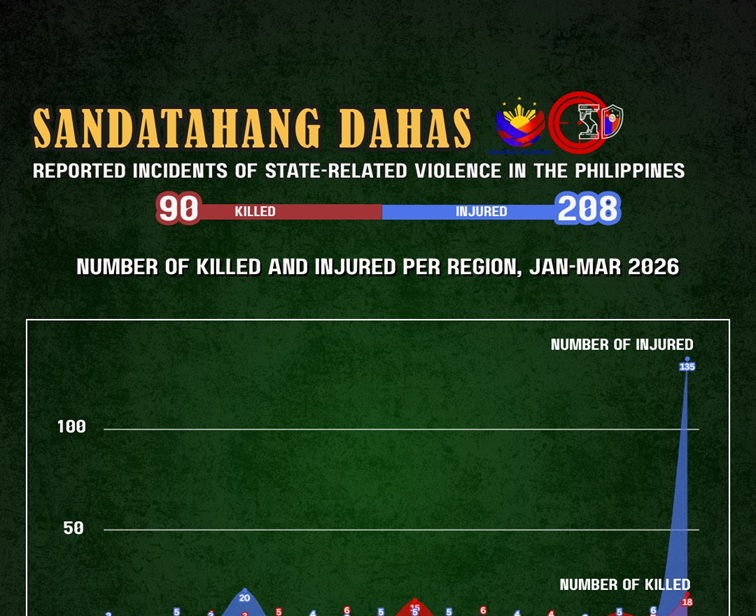
What Tulfo’s trenchant criticism failed to mention is that certain members of the government’s armed personnel are not only violent when they are performing their duty—they are as violent off of it and in dealing with hapless civilians. Sandatahang Dahas’s March 2026 data offer proof to these circumstances and to the alarming number of attacks against state agents outside of official operations.
State agents are justified to use lethal force when in the pursuit of their duty all other means have been exhausted and that their lives or those of others are in imminent danger or injury from the attacker. However, in March 2026, Sandatahang Dahas recorded disturbing incidents of state forces resorting to lethal and injurious violence in personal disputes. There were also cases of firearms misuse to what was being made to appear as due to personal negligence. Whichever the case, as authorized arms bearer by the state, their actions reflect on the state’s capacity to instill in them the discipline to always uphold the lawful and justifiable use of force regardless of whether they are on duty or not.
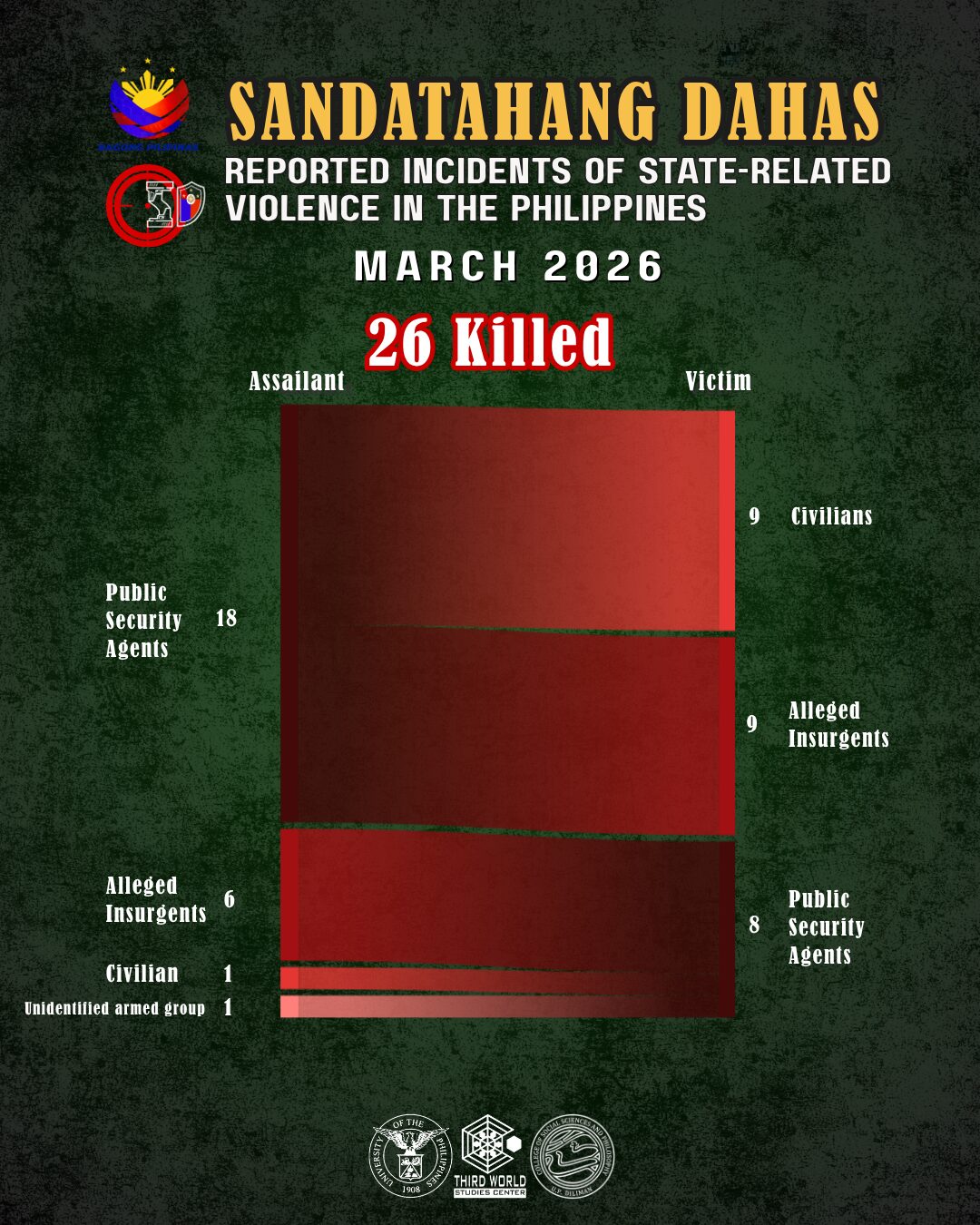
In March, 26 were killed and 30 injured in incidents of state-related violence. Of the 26 killed, nine were civilians, nine were alleged insurgents, and eight were state agents.
Three of the civilians were killed by state agents outside of their law enforcement responsibilities. On March 1, 47-year-old Ariel Peligro was shot by Private First Class Ronie Bendisula Jr. of the Philippine Army at a diner in Polomolok, South Cotabato. For unknown reasons, Bendisula just started shooting inside the diner and hit Peligro twice. Some of the patrons ganged up on Bendisula to subdue him. Both were rushed to a hospital, but only Bendisula survived. While he is now in police custody, an investigation is still ongoing as to what triggered the shooting. According to reports, Peligro identified as part of the LGBTQ.
Personal disputes led to several instances of state-related violence this month. On March 2, Department of Public Works and Highways (DPWH) engineer Karen Grace Corsino del Valle was killed by her boyfriend, Sgt. Jerome Tejero, in front of the Regional Trial Court in Catarman, Samar. She had been scheduled to appear in court due to a violence against women case she filed against Tejero. Her brother, Kent John Corsino, who had accompanied her, was also left injured. A PHP 100,000 bounty for Tejero, who escaped shortly after shooting at the siblings, has been offered by the DPWH secretary Vince Dizon and former congressman Paul Daza.
An “old grudge” is being seen as the motive behind the shootout between Noriel Deocampo Duronio, a farmer, and Kerwin Jay Tongu-an Puada, a CAFGU member. On March 15, Duronio reportedly barged into Puada’s house in Maayon, Capiz at one in the morning as he was sleeping. Duronio then shot Puada in the shoulder. Puada immediately retaliated by shooting him in the head; Puada survived, Duronio did not.
More state agents were harmed in similar incidents occurring outside of their official duties. On March 23, Jomar Florentino and Jade Querubin, two police master sergeants, met up at a private cemetery in Lapu-Lapu City, Cebu to settle what investigators called a long-standing animosity. While Querubin was inside his vehicle, Florentino reportedly shot at him eight times, leading to a bullet fragment grazing his head. Florentino has since been charged with frustrated murder. Both personnel have been relieved from their posts and have had their issued firearms confiscated.
On March 8, Police Master Sargent Jose Uring was shot dead by two assailants on the basketball court of a private subdivision in Bulacan. He had just come from a caucus about the upcoming elections for the Homeowners Association, in which he was reported to be running for president. A bystander, Jonilyn Acedera, was wounded in the crossfire, with the bullet hitting her knee. The assailants have since been arrested while Acedera recuperated in the hospital.
Of the eight state agents killed in March, six died through ambushes—all on the same day. On March 28, five patrolmen died while three other policemen were injured in Shariff Aguak, Maguindanao del Sur. They were ambushed as they were on their way back to their headquarters at around 9:00 in the evening. Captain Steffi Salanguit, spokesperson of the Police Regional Office in BARMM, stated that the Dawlah Islamiyah was behind this attack. The attackers also reportedly stole firearms from the victims. Earlier that day, Corporal Walid Buleg Sangcopan and his civilian companion were shot by motorcycle-riding assailants in Saguiaran, Lanao del Sur, leaving both dead. Salanguit stated that the Dawlah Islamiyah were not responsible for this attack; rather, a rido (a conflict between clans) may have been the motive.
Nine alleged insurgents were killed by the Philippine Army in March 2026, all during law enforcement operations. Of these, eight were NPA members while one was reported to be a Dawlah Islamiyah leader.
On March 18, the body of an alleged NPA member was found in Moises Padilla, Negros Occidental. His name was Edgar Tingting, alias “Pagat,” and he was reportedly shot in an encounter with the 62nd Infantry Battalion in Guihulngan, Negros Oriental a day before.
Four days later, another NPA member was killed in Donsol, Sorsogon. Jason Mosteles, also known as “Justine” and “Jake,” was killed in an encounter with the 31st Infantry Battalion. In the crossfire, a civilian named James Quiñones was hit while on his way to his child’s moving up school ceremony, causing his death. While authorities state that a stray bullet possibly killed Quiñones, his mother insists the opposite as her son was riddled with bullets when they found his body. Until the ongoing investigation determines who shot Quiñones, we cannot include him in our count of deaths resulting from state-related violence.
Of the 26 dead, 25 were men while one (del Valle) was a woman. While an alarming increase in deaths resulting from “attacks against state agents” and other circumstances outside of state agents’ official duties was noted, law enforcement operations still cause most of the state-related killings in March, at 17.
Similar to the killings recorded in March, injuries resulting from state-related violence did not just occur during official law enforcement operations. Shootings claimed to be accidental were recorded this month on two consecutive days. On March 10, a 41-year-old woman was shot by a patrolman who was cleaning his gun in Batac, Ilocos Norte. The policeman has since been held under restrictive custody while the victim was hospitalized. Similarly, alias “Boy” was injured by a police escort in front of the Manila City Hall on March 11. He was just passing by the area when the policeman reportedly pulled the trigger by accident.
State agents abuse their power beyond the wielding of their guns. As in 2025, sexual violence committed by state agents continues to be monitored by Sandatahang Dahas in 2026. One victim, a 23-year-old police trainee, reported that she was raped by her police instructor in Teacher’s Camp, Baguio City, on two separate incidents. The first occurred on January 20 while the second instance was on February 8. The victim filed a formal complaint last April 13. Charges are reportedly being filed against the suspect, whom authorities refused to name, but mentioned that he was a married 41-year-old officer from Pangasinan.
On March 15, a policewoman was reportedly harassed by Police Brigadier General Jessie B. Tamayao of the PNP-Highway Patrol Group (HPG). The incident happened right at the PNP-HPG headquarters at Camp Crame, Quezon City. He had reportedly groped her inappropriately while threatening that he would reassign her to Mindanao if she refused to entertain his advances. After the victim formally filed a complaint with the National Police Commission, Tamayao has resigned while maintaining that he has “never been involved in, nor subjected to, any such allegation or complaint.”
In addition to the three policemen injured by the Dawlah Islamiyah in Maguindanao del Sur, two more state agents were harmed by alleged insurgents. On March 29, Corporals John Ryan Dango and Ramche Perez were wounded during an encounter with the NPA in Occidental Mindoro. The incident also led to the death of Captain Dean Buen Oyando and the capture of an NPA member. Sandatahang Dahas has noted increased activity between the Armed Forces of the Philippines and the NPA in Occidental Mindoro since the start of the year. Between January and March, five soldiers have been harmed (four wounded, one killed), while one alleged NPA member has been killed in the province.
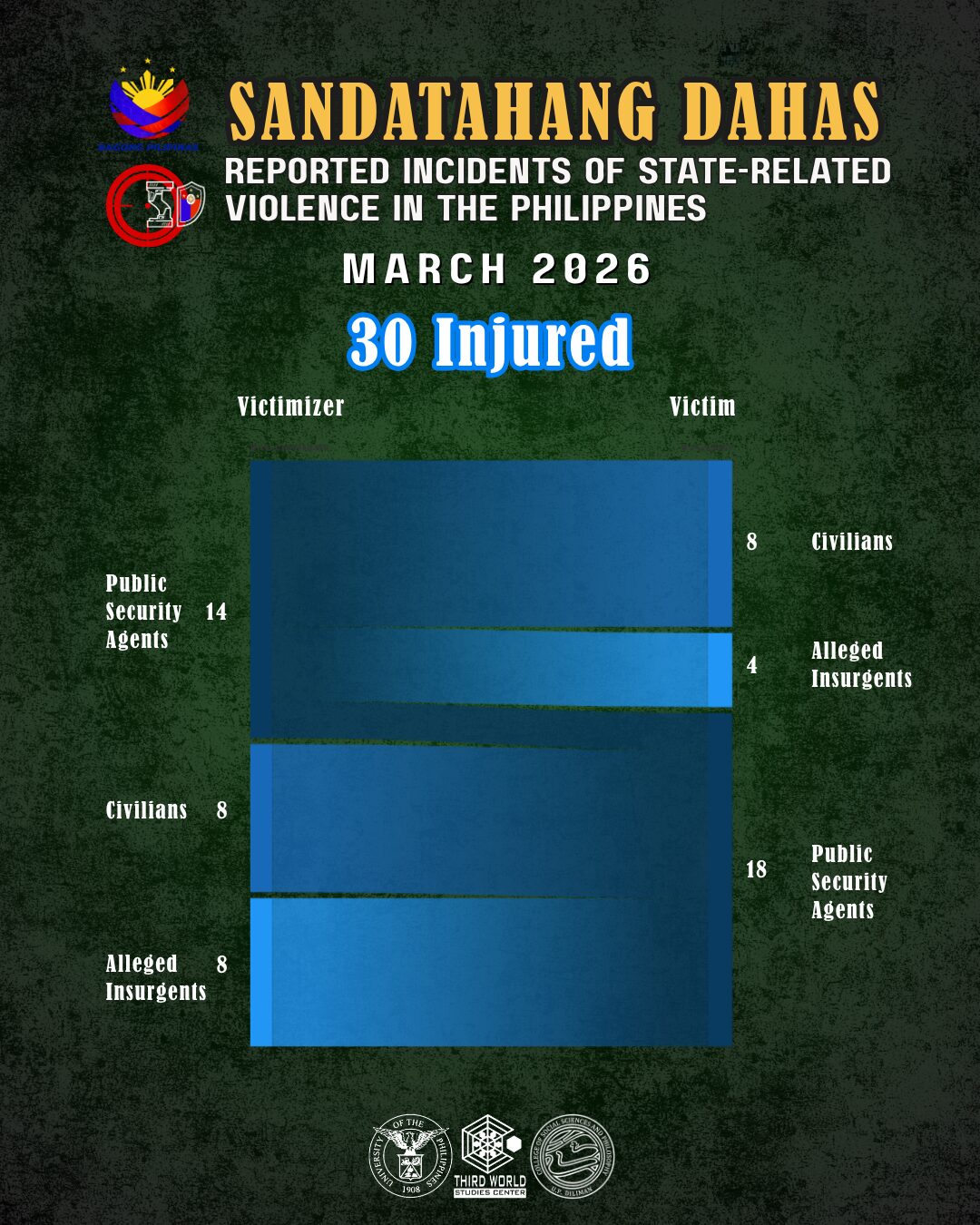
A total of 30 individuals were injured in incidents of state-related violence in March: eight civilians, four alleged insurgents, and 18 state agents. Of these, 24 were men, three were women, and three were individuals whose sex was unreported in the news.
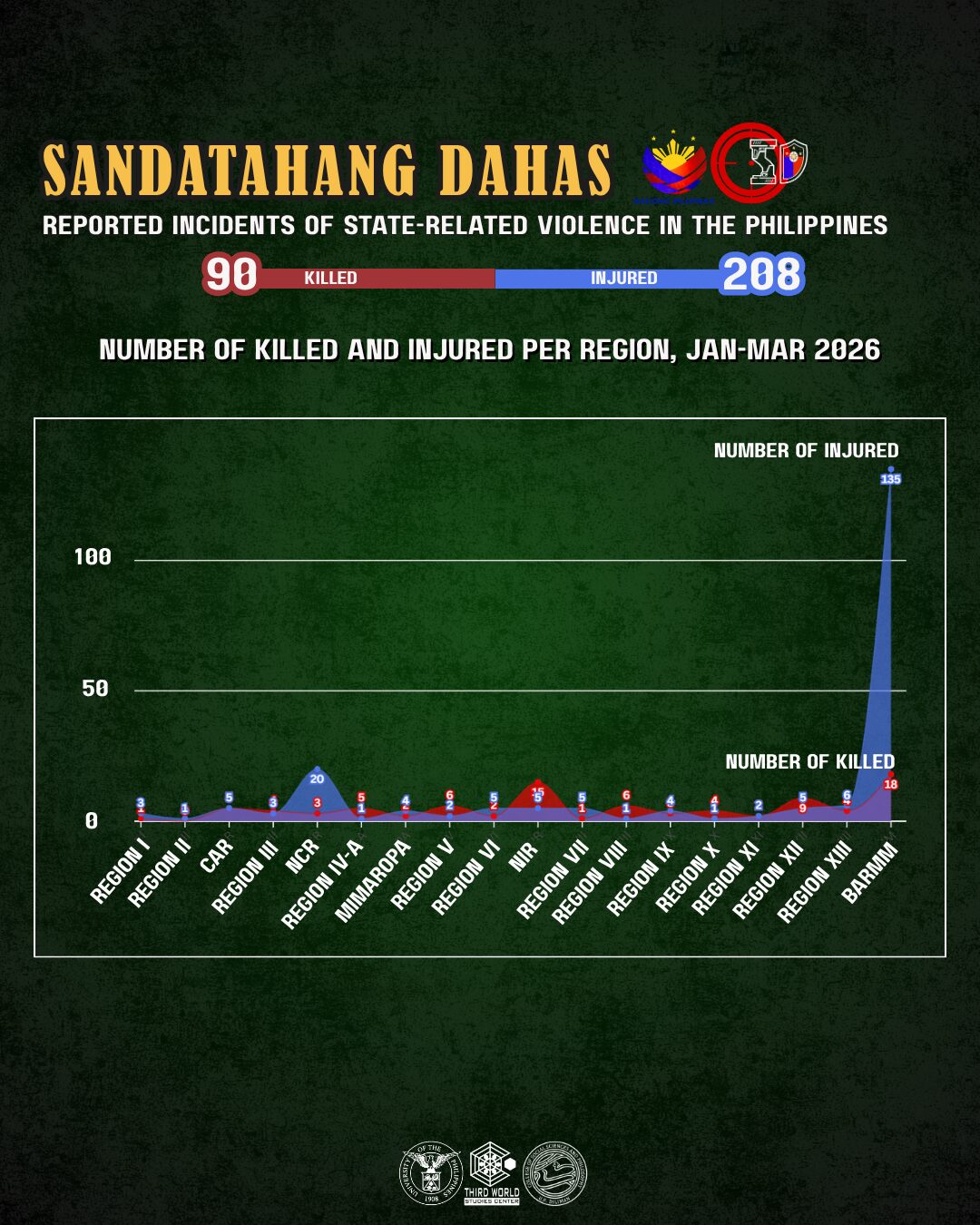
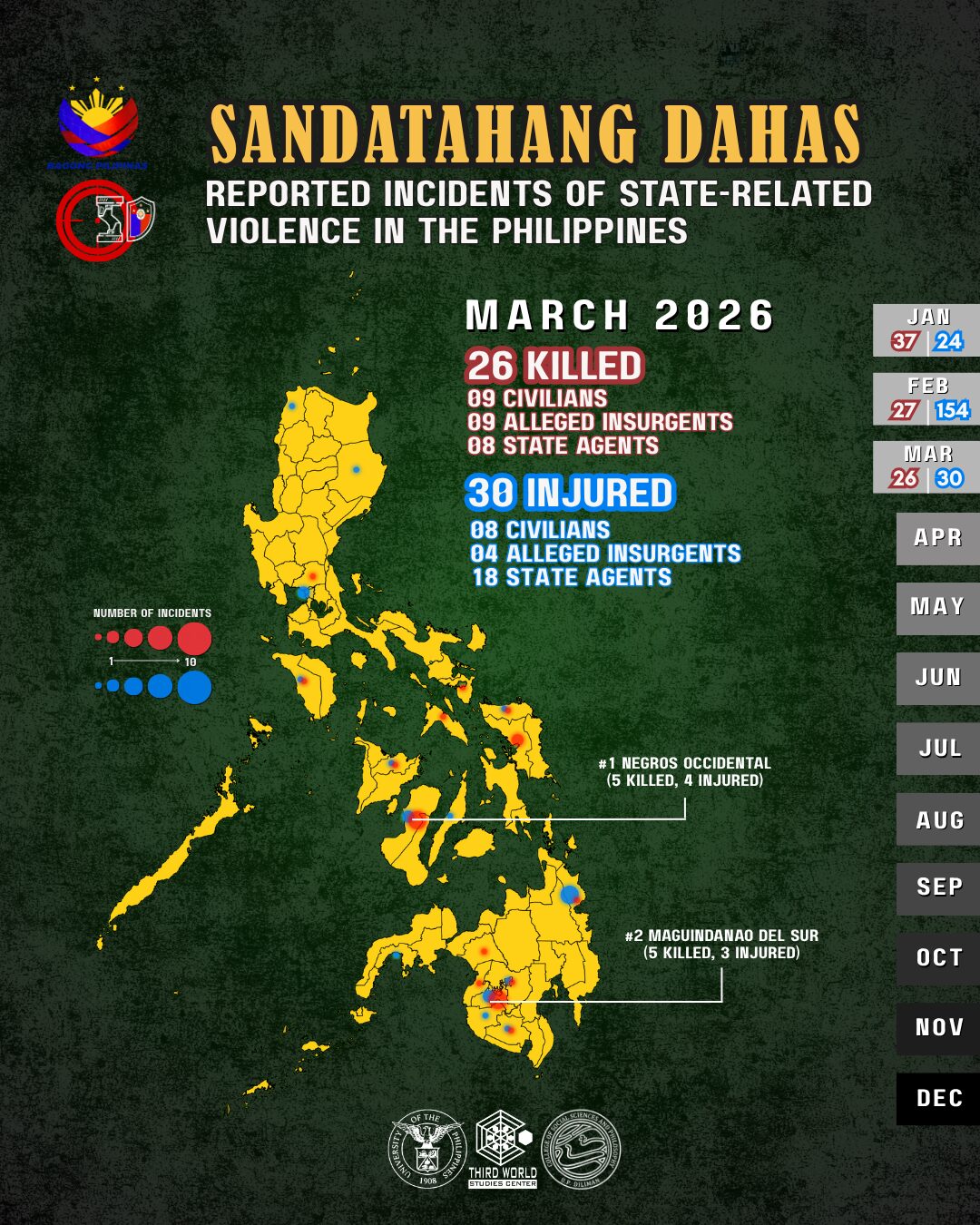
Mindanao was the center of state-related violence in March, with 13 killed and 13 injured. Maguindanao del Sur and Surigao del Sur were recorded as hot spots, with the former having eight incidents (five killed, three injured), and the latter having seven (two killed, five injured). All of these incidents involved alleged insurgents as both victims and perpetrators. Cotabato followed with two killed and two injured. Two cases were reported each in neighboring South Cotabato (one killed, one injured) and Maguindanao del Norte (two killed). Lastly, Sultan Kudarat and Zamboanga Sibugay each reported one injured individual, while Lanao del Sur reported one killed.
Second to Mindanao was Visayas, which had nine killed and eight injured. Negros Occidental was the province with the most number of incidents of state-related violence in March, with five killed and four injured. Samar had two killed while its neighbor Northern Samar had one killed and one injured. Capiz and Cebu recorded two cases each, with the former having one killed and one injured, and the latter having two injured.
Lastly, Luzon had the least number of incidents of state-related violence in March, an occurrence that was last recorded by Sandatahang Dahas in June 2025. A consistent hot spot of violence, the National Capital Region had the largest number of incidents in the island group, with four injured. Occidental Mindoro comes in second, with one killed and two injured. Ilocos Norte reported two injured; Bulacan, Masbate, and Sorsogon, one killed each; and Isabela, one injured.
Incidents of state-related violence in March show significant cases of state agents harming (and being harmed) in situations that do not fall under their duty to maintain public security. The instances highlighted in this report question whether state agents—in particular the PNP—are actually using their service firearms in the honest pursuit of their duties. At the same time, an increase in ambushes and attacks against state agents foreshadowed an eruption of violence in the succeeding months.
[Aidrielle Raymundo is a university research associate at the Third World Studies Center (TWSC), College of Social Sciences and Philosophy, University of the Philippines Diliman. She also did the graphics accompanying this report. The data for this monthly monitor were compiled with the assistance of TWSC university researcher Joel Ariate and TWSC student assistants Nadine Castillo and Eugene Claire Belen Espino. To learn more about Sandatahang Dahas, visit its website and for the latest updates, follow the Sandatahang Dahas in these social media platforms: X (formerly Twitter), Instagram, Threads, and Bluesky.]