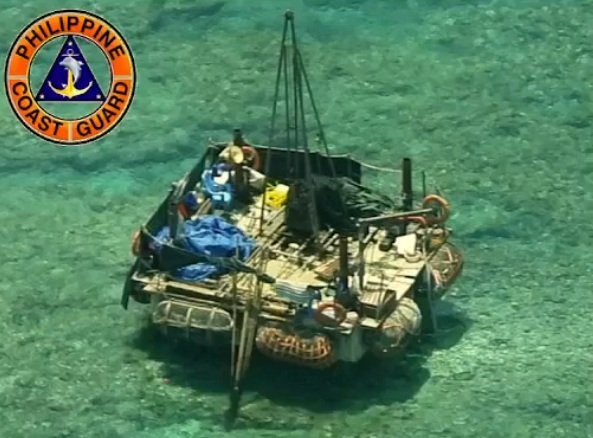

Since May 2026 we had been witness to the latest display of Chinese control over the Philippine maritime geographic feature known as Bajo de Masinloc/Scarborough Shoal. We were also witness to the weak Philippine responses to it. Eventually China withdrew the raft that it said was part of its so called efforts to undertake comprehensive research in the South China Sea. In response Manila stated that “While we take note of the removal, we reiterate our principled and unyielding position: Bajo de Masinloc is and will always be an integral part of Philippine territory…”
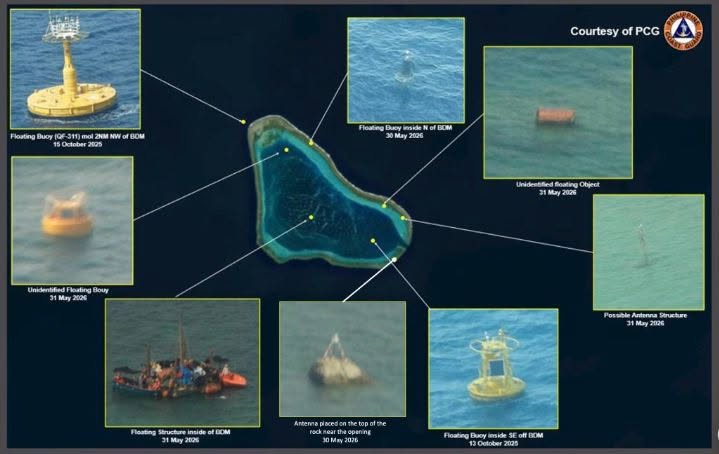
Yes, it is our unyielding position that it is an integral part of our territory that unfortunately for many questionable reasons we physically abandoned to the Chinese back in 2012. Had we not done that and had we adopted earlier proposals to do to BDM/Scarborough what we had done at Ayungin Shoal then perhaps we would not have that problem of attempting to verbally assert control over territory we unwisely physically abandoned to the Chinese.
The earlier proposal on grounding an obsolete Philippine Navy vessel at BDM/Scarborough Shoal almost came to fruition in the same time that the successful operation at Ayungin Shoal took place. Unfortunately the administration balked on that despite the fact that BDM/Scarborough is a strategically important location due to the fact that it is only several hundred kilometers away from governance, commerce, and military centers of gravity of the Philippines. Those would be the National Capital region, the airports and port facilities in both Manila Bay and Subic Bay, and the chain of military bases of the Armed Forces of the Philippines from Southern Luzon, the NCR all the way to Central Luzon.
The inability of successive administrations in the Philippines to put Scarborough into that context of it being a physical existential threat to our survival if it falls into the hands of our adversaries is absolutely mind boggling. The cavalier and dismissive attitude in the way that our physical control of it was handled that eventually led to its control by China is well worthy of condemnation. Especially since it appeared nothing was learned from China’s earlier seizure of Mischief Reef in 1995. In 1999 onwards there were also additional proposals to establish a new lighthouse manned by Philippine personnel but nothing was done because out of sheer naivety or outright stupidity, all these successive administrations just neglected the situation. This was despite the fact that by 2009 Beijing was introducing vessel after vessel into the fleets of its maritime agencies and had begun making declarations that any attempts to interfere with activities of Chinese fishermen will be met with a response from China.
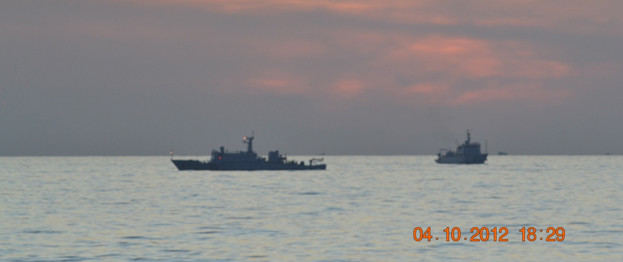
Then one day, in April 2012, BRP Gregorio del Pilar attempted to accost Chinese poachers in BDM/Scarborough Shoal and was met by two Chinese maritime vessels that blocked it. That resulting standoff resulted in an outright Philippine defeat when the Obama administration was unwilling to deal with any crisis in the region and instead forced the Philippines to accept a negotiation that was supposed to see both the Chinese and Filipino sides withdraw from the shoal.
Now any student of maritime and land disputes knows that losing physical control puts any party engaged in the crisis at a severe disadvantage. Hence as China accepted the agreement brokered by the Obama administration, it had two fingers crossed behind its back and predictably reneged on what was agreed upon. That should have been enough reason for the Philippines to steam back to Scarborough and challenge the Chinese vessels there.
Unfortunately the Philippine government lost its nerve citing the U.S. abandonment of Manila as the reason for that. Hence, it was a double whammy of the Philippines losing its nerve to physically challenge China in Scarborough, but also losing its nerve in ensuring that the Americans honor their commitments to Manila in light of the PH-US Mutual Defense Treaty and supporting documents.
The MDT stated the following:
“4. Article V of the MDT further provides that “an armed attack on either of the Parties is deemed to include an armed attack on:
- the metropolitan territory of either of the Parties, or
- on the island territories under its jurisdiction in the Pacific Ocean, and
- its armed forces, public vessels or aircraft in the Pacific.”
As for supporting documents, more than a decade prior to the Scarborough standoff, then U.S. Ambassador to the Philippines Thomas Hubbard sent a letter to the Philippine Foreign Affairs Secretary in 1999 stating that:
“the US Government stands by its statements in the Vance-Romulo letter of January 6, 1979.” Moreover, in the same letter, Amb. Hubbard cited Defense Secretary William Cohen’s statement that “the US considers the South China Sea to be part of the Pacific Area.”
That letter was part of the effort to sweet talk the Philippine government and especially the Philippine Senate to ratify the Visiting Forces Agreement.
Now, what the Philippines cannot seem to comprehend is that a treaty alone is insufficient to ensure compliance by both signatories. It is the actions taken by one signatory to ensure and compel that the other signatory complies is what is equally important. This is because despite a treaty, the actions of a signatory are determined by the significance of the crisis to its national security interests.
That appreciation of how treaties are enforced was missing in 2012 when the Philippines willingly withdrew from BDM/Scarborough. The MDT did not automatically compel the U.S. to honor its obligations and to do that, Manila should have sent back its ships to Scarborough and stubbornly stayed put regardless of what the Americans would think of that. BDM/Scarborough after all is in our own front yard threatening our centers of governance, commerce, and defense.
Would the Obama administration then want to risk its reputation among America’s allies worldwide that it was unreliable and not a dependable partner as Philippine ships were left alone to face the Chinese might? That action would have dragged the Americans kicking and screaming back to the negotiating table with the Chinese to hammer out a better agreement where the Chinese ships would leave Scarborough and in our possession.
Historically, the Philippines approach to foreign aggression to its territories has frequently been to engage in both legal and diplomatic actions due to its predilection for feeling weak and ignoring its strengths. In fact there were times that the Chinese vacated Scarborough due to typhoons and yet the Philippines was not even willing to send a flotilla to seize control of the unguarded shoal. This is worlds’ apart as to how the Philippine government deals with its citizens engaged in rebellion who are frequently met with deadly overwhelming military force.
China’s approach on the other hand is that of a practical and decisive application of who physically controls eventually determines ownership. Hence, the Philippine side tends to yield territory with little or no thought of the strategic implication to its own defense as the Chinese slowly advance. For example, in Russia’s war of aggression against Ukraine, Ukrainian drones have been hammering targets in Moscow 300 miles away. Scarborough Shoal is half that distance from Metro Manila, well within the range of whatever the Chinese will in the future deploy there especially if they construct facilities in the shoal.
As long as the Philippines continues its current approach to Scarborough Shoal of monitoring, legal action, and diplomatic protest, there is no chance that it will be able to assert physical control over that feature in anyone’s lifetime. To do so, it will once again have to physically deploy ships to establish a controlling presence in Scarborough Shoal to have a chance of achieving actual control. What the Philippines fails to understand once again is that in 2012, it was weaker than what it is now and yet it faced off the Chinese to a standstill at Scarborough for almost two months. If China had wanted war then it could have effortlessly sunk those vessels the Philippines had sent there but they
did not because Beijing was well aware of what would be the repercussions if those Filipino ships were harmed. What the Chinese were doing was that they kept on pressing other buttons like trade and tourism in order to weaken Filipino resolve which were not enough to cause the collapse of the Philippines since all that we should have done was just to weather it and look for different markets. What made matters worse that a squabble broke out in the Philippine side among factions assigned to the diplomatic aspect of the BDM/Scarborough crisis which muddled the situation more for the Philippines. Yes, we are our own worst enemy. Hence it came to pass that the Philippine side blinked, lost control of the shoal, and instead dogmatically pursued the legal arbitration route as the Chinese were left in possession of the area.
Today our Coast Guard has more ships than it previously had, while the Philippine Navy has finally tentatively entered the 21st Century. I say tentatively because many of its ships are still at the Fitted For But Not With stage. Meaning to say the procurement of their major weapons and combat systems is still dragging along at a slow pace. Does the Philippines finally have the wherewithal to launch a campaign to eventually physically regain Scarborough? Yes it does as it has more than adequate assets to do so. Actually it always had that capability even in 2012 as our naval and coastguard personnel did their duty to hold the line at Scarborough and only withdrew when ordered to do so by the Philippine government. The Chinese did not force them out.
We currently have more allies and partners than we had in 2012 as Japan, Australia and even a number of NATO countries have all sought to involve themselves in freedom of navigation in the South China Sea and even to equip our coast guard and military. The United States is still there as our treaty ally, still as unreliable, and with a President who is corrupt and unhinged, but it has its uses because it will always make China guess if the Americans will respond to whatever mischief Beijing does in the region and against the Philippines. That is where the arbitration victory has been valuable as it has mobilized international opinion on our side. However such opinion will not force China to give back Scarborough to the Philippines. The Philippines has to initiate that.
Does the Philippines then have the will to carry out an operation to liberate Bajo de Masinloc/Scarborough Shoal from Chinese control? Well my friends that’s another story, for another time.
The views in this column are those of the author and do not necessarily reflect the views of VERA Files.