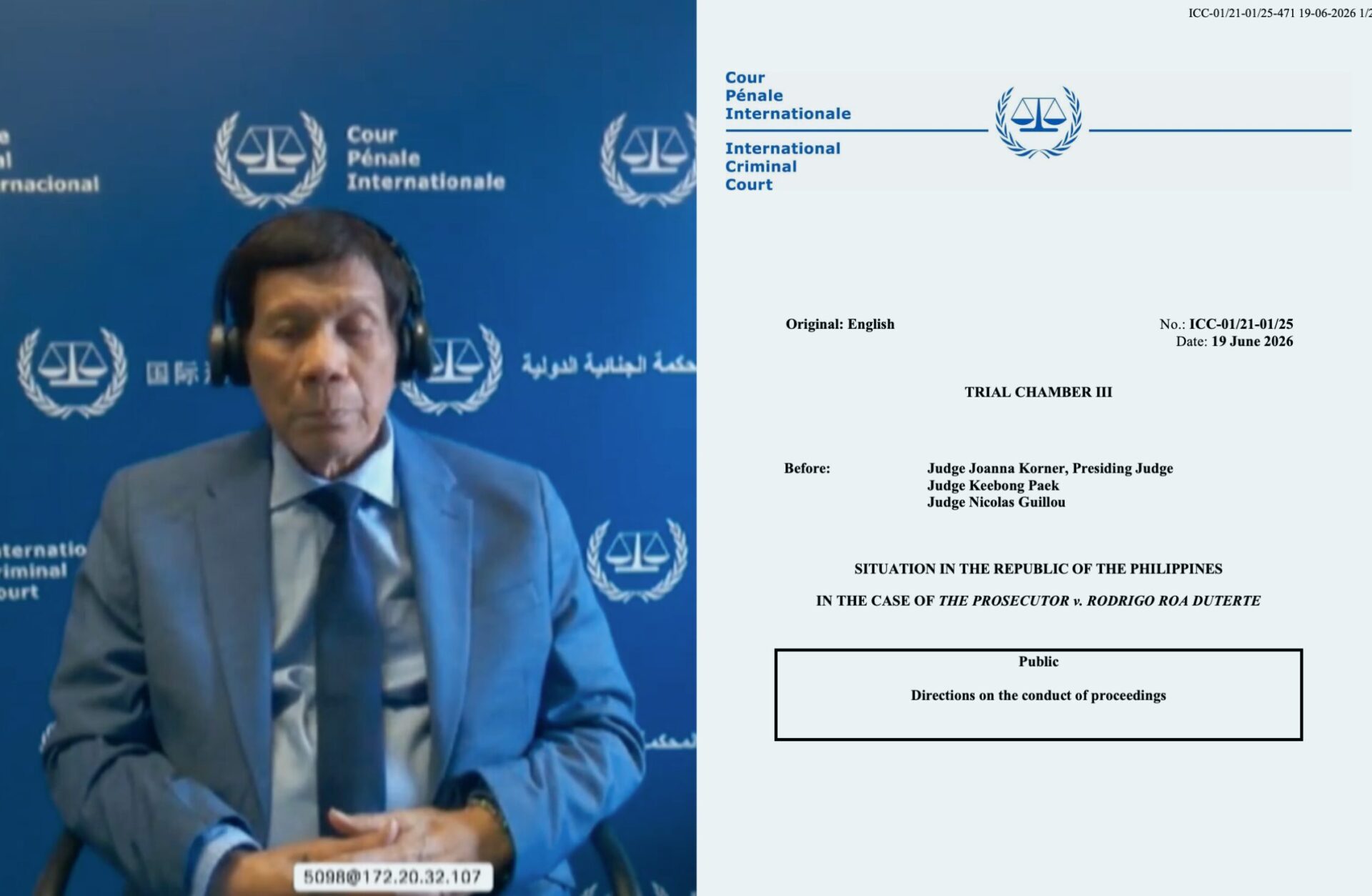
The International Criminal Court has laid down the procedures for the trial of former president Rodrigo Duterte on charges of crimes against humanity, with the formal reading of charges set at the opening of proceedings on Nov. 30.
In a decision dated June 19, ICC Trial Chamber III outlined the structure of the trial, guidelines on the presentation of evidence, order of witness questioning, protective measures, and rules on the public disclosure of records during the proceedings.
The chamber directed the Office of the Prosecutor to submit by Aug. 31 its trial brief containing its final list of witnesses, evidence to be presented, and legal arguments.
The Common Legal Representatives for Victims have until Sept. 28 to file their trial brief, while Duterte’s defense team was ordered to submit by Oct. 30 the legal issues it disputes with the prosecution and the general nature of its defense.
“The chamber reiterates that this filing does not preclude the defense from raising further issues at a later stage if these become evident in the course of the trial or the defense’s investigations,” the chamber said.
Trial procedures
Under the trial schedule, the prosecution will present its opening statement first, followed by the CLRV and the defense. The prosecution has been allotted six hours for its opening statement, while victim representatives will have three hours. The duration of the defense’s opening statement will be determined later.
Proceedings will then move to the presentation of evidence by the prosecution, followed by the CLRV if authorized, and subsequently by the defense.
The chamber said evidence may be presented in documentary, digital, or physical form and will be evaluated based on its relevance, probative value, and potential prejudice.
“During its deliberations, the chamber will consider all the standard evidentiary criteria for each item of evidence submitted, though it may not necessarily discuss in the judgment every submitted item,” it said.
Parties must seek the chamber’s approval before introducing rebuttal or rejoinder evidence.
The judges also established guidelines for witness testimony. The party calling a witness will conduct the initial examination, followed by questions from victim representatives, if any, and then by the opposing party.
Parties may question witnesses on their credibility, the reliability of evidence, and mitigating or aggravating circumstances, provided these are relevant to the case.
“The chamber will ensure that the questioning by the non-calling party is conducted in accordance with its responsibility for the protection of victims and witnesses under Article 68 of the Statute,” the chamber said.
Judges may pose questions to witnesses at any stage of the proceedings, including after questioning by the parties, while the defense will have the final opportunity to examine witnesses.
Protective measures for witnesses
The prosecution was given until Oct. 30 to seek protective measures for witnesses, although such measures may be modified should new information emerge before testimony is given.
While witness testimony will generally be heard in public, the chamber said parties must ensure that questioning during public sessions does not compromise witness protection. Hearings may be held in private or closed sessions when necessary, but such measures should be “limited to what is strictly necessary.”
The chamber also ordered that filings and transcripts be made public or released in redacted form. In urgent situations, rulings may be issued by email to the parties and later entered into the official record through quarterly reports beginning Sept. 1.
The next status conference is scheduled on June 23, during which parties are expected to discuss deadlines for submissions on a fresh medical assessment of Duterte, the adoption of a protocol for handling confidential information, and issues concerning “public statements made by counsel.”
Duterte, who was excused from attending the June 23 proceedings at his request, also did not appear during the initial status conference held on May 27.
A third status conference is scheduled for July 14 as the court addresses procedural matters ahead of the trial.
Duterte is facing three counts of murder as crimes against humanity in connection with thousands of deaths linked to his administration’s anti-illegal drug campaign.