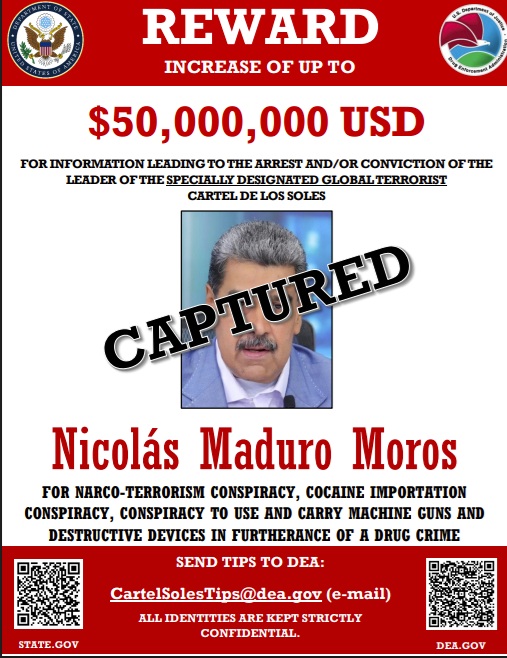
Nicolas Maduro was a scoundrel to say the least. As dictator of Venezuela, he was responsible for the economic mismanagement that led to massive hardship for the people, he cheated in elections, he and his cronies plundered the country’s coffers, his government engaged with foreign terrorist organizations, and his family was involved in criminal activities in the region. Just like Hugo Chavez before him, he faced unrest in Venezuela either in the form of protests from the political opposition, to plots to unseat him hatched by ex-military members backed by foreign based organizations. To suppress dissent, the Venezuelan security forces resorted to brutal operations wherein a total of almost 20,000 people have been extra judicially killed since 2016. There is no redeeming quality in Maduro and that is exactly why he was a low hanging fruit for the United States under Donald Trump to flex its military muscle.
Hostility seeds planted by Hugo Chavez
The troubles between the United States and Venezuela had been going on even before the rise of Maduro. His predecessor, Chavez, had run afoul of the Americans due initially to his left wing policies and then ultimately to his engagement in activities that were perceived as inimical to U.S. national security such as support for Iran, Cuba, and Libya. Previously, Venezuelan political leaders tended to be very supportive of the U.S. It was Chavez who ended that in favor of nationalistic and socialist policies. However, Chavez had a hot and cold relationship with the Americans which although there were moments of strain, it still did not result in any substantial disruption. The substantial deterioration of relations was during Maduro’s accession as president of Venezuela following the death of Chavez in 2013.
By Maduro’s term, all pretense of following socialist principles in the governance of Venezuela had been thrown out of the window as brutal repression and massive corruption became the preferred policies of his administration. Worse was that Maduro’s links to transnational criminal activities involving illegal drugs became a bipartisan concern for the U.S. During the Obama administration, two nephews of Maduro were arrested by the Americans for attempting to bring into the U.S. 800 kilos of cocaine. Meanwhile, Maduro was heavily criticized for the economic downturn that was affecting Venezuela and causing hundreds of thousands to try to flee the country. His response though was to be more repressive. He brushed aside all attempts to recall him as president, and he stripped the elected National Assembly of its powers. He was then subsequently accused of cheating massively in the 2018 and 2024 national elections in order to win the presidency. Faced with sanctions against the Venezuelan government from the U.S. and other countries, Maduro then opened the cash strapped country to China and Russia who were avidly eyeing the massive crude oil reserves there.
Revival of Monroe doctrine
The victory of Trump in the 2024 U.S. elections spelled trouble for Maduro. The new administration began to depict Venezuela under Maduro as a threat to U.S. national security. By November 2025, the
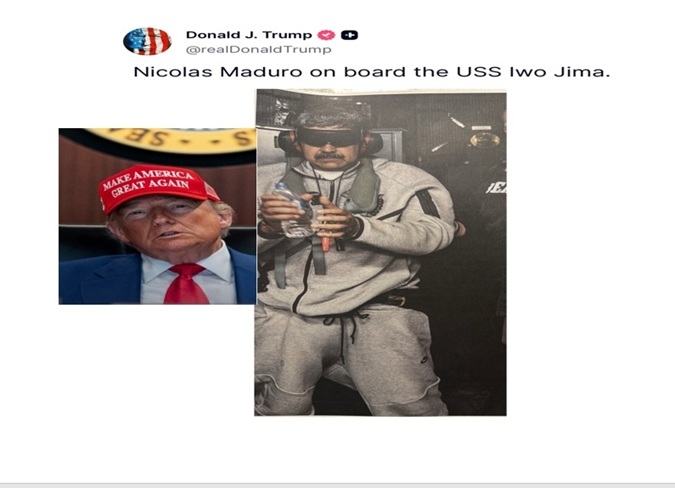
U.S. designated the Venezuelan dictator and his officials as members of a foreign terrorist organization. Strikes in the Caribbean were being conducted by American military forces against boats allegedly carrying illegal drugs while a build up of U.S. forces arrayed against Venezuela transpired. Maduro then enlisted the support of both the Russians and Chinese who sent delegations and weapons systems to Venezuela as expressions of solidarity. In December 2025, the U.S. released its national security strategy that announced a Monroe Doctrine revival in the Western Hemisphere wherein it stated that no rival of the Americans will be allowed the ability to establish a presence there to the detriment of U.S. interests. The following year, on Jan. 3, the U.S. launched an operation against Venezuela that saw the capture of Maduro and his wife, and their transfer to the U.S. to face drug running charges.
The aftermath of Maduro’s fall has seen countries split on how to properly respond to it as it is widely seen as a violation of international law. However the criticism is muted due to the fact that Maduro is indeed directly responsible for the suffering inflicted on the Venezuelan people by his dictatorial policies, mismanagement of the government, massive corruption, and widespread human rights abuses. Maduro is definitely no saint, socialist or otherwise, in the same vein that the one who ordered his abduction is definitely no saint himself, Donald J. Trump.
Trump eyes Canada, Denmark next
It is the concern that the international community has with what else will Trump do as he has publicly declared the desire to have territorial expansion at the expense of Canada and Denmark. Understandably, other Latin American countries such as Colombia and Mexico have voiced their concern about what the U.S. did, and they have been met with threats and ridicule from the U.S. government. Argentina though, which is governed by a thriftshop version of Trump, has supported the U.S.
The U.S. government though has shown some willingness to work with officials identified with the Maduro regime in the meantime. Surprisingly, Trump brushed aside Maria Corina Machado, the Nobel Peace Laureate and leading opposition leader in Venezuela, as he flippantly stated that she was not respected in her own country despite she having won the opposition primaries for the 2024 elections. This snob from Trump was not well received by the Venezuelan political opposition and there are concerns about his declaration that the U.S. will govern the country. The last thing that the Americans need in Venezuela is fighting among political factions there that will only weaken the puppet government that they seek to impose.
In modern post war history, the U.S. has won battles but has frequently lost the peace. This happened in Vietnam, Iraq, and in Afghanistan. It remains to be seen if history will repeat itself in Venezuela, and from the looks of it, the situation does not look promising for the Americans and is more complicated and convoluted than they make it appear.
Thumbnail photo from state.gov
Jose Antonio Custodio is a military historian who also dabbles in national security and defense commentary. He sometimes teaches when he has the opportunity to do so, and has authored articles and co-authored books on military history. He is also an unabashed ailurophile, an unrepentant bibliophile, and an avid scale modeler.
The views in this column are those of the author and do not necessarily reflect the views of VERA Files.