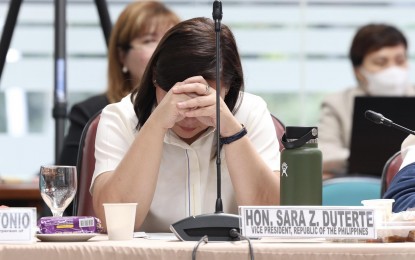

Vice President Sara Duterte and her camp have settled into a familiar playbook when facing scrutiny over confidential funds, impeachment and other criticisms.
They deflect accountability by branding nearly every question as politically motivated, driven by rivals, not by a genuine demand for answers. They retreat into technicalities, question procedures, and cite loopholes to avoid direct responses.
That’s why many were no longer surprised when her legal team submitted a “Consolidated Verified Answer” to the House Committee on Justice, which several lawmakers called a prohibited pleading for failing to address any substantive allegation in the impeachment complaints.
Instead of clearing her name, she has chosen to stretch the conversation, shifting the narrative from financial scrutiny to political conflict, from ethical questions to technical compliance.
The vice president has turned evasion into strategy. She generates noise while withholding answers, reinforcing a narrative of martyrdom that has become central to the Duterte family’s political currency.
This silence is not just a legal tactic. It echoes the Dutertes’ broader messaging, particularly the “kidnapping” narrative. On March 11, 2025, former president Rodrigo Duterte was taken into custody by the International Criminal Court. His allies framed the arrest as a betrayal, an alleged “kidnapping” orchestrated by the Marcos administration in coordination with the ICC.
They have ignored repeated rejections by the court’s pre-trial and appeals chambers on claims of kidnapping, illegal detention, and lack of jurisdiction, testing the court’s patience, perhaps hoping for eventual sympathy for the aging former president.
As the House justice committee prepares for formal impeachment hearings beginning March 25, the same pattern is likely to hold. Attendance is optional, and her camp has already raised objections, citing limits such as the inability to cross-examine witnesses.
We’ve seen this before. When questioned separately by House committees on appropriations and good government over the Office of the Vice President and the Department of Education’s spending from 2022 to 2024, she deployed the same tactics: framing inquiries as political attacks, challenging jurisdiction, and leaning on procedural defenses.
She declined to provide specifics, citing national security. She insisted that only the Commission on Audit has the authority to examine such expenditures. At the same time, she maintained she was not being evasive, only that Congress had no right to ask.
Her allies have amplified the message: She is being singled out, not scrutinized, targeted to derail a possible 2028 presidential run.
Silence as a strategy
Sara Duterte’s silence in the House may be the loudest part of her 2028 positioning. Every unanswered question signals to supporters that the current administration is illegitimate. Every delay reinforces a narrative of persecution.
Her refusal to fully engage is a calculated risk. By not directly rebutting evidence, including the affidavit of former aide Ramil Madriaga alleging misuse of confidential funds, she allows the case to advance largely uncontested.
The affidavit has become central to the proceedings. While she has dismissed the whistleblower as a fraud and even linked him to criminal claims, the House justice committee has deemed the allegations sufficient to proceed.
On its face, this looks like a losing legal strategy. As committee leaders have noted, unrebutted evidence strengthens the case for probable cause. But the vice president is not arguing before Congress alone; she is appealing to the public.
By questioning the authority of institutions and recasting scrutiny as betrayal, she turns a corruption probe into a narrative of political persecution. If removed, she does not fall as a disgraced official but rises as another “wronged” Duterte, echoing the same narrative tied to her father’s arrest.
The danger of this rhetoric is institutional. When a lawful arrest is framed as abduction, and refusal to answer questions is cast as resistance, accountability erodes.
The House is poised to move forward, with impeachment potentially reaching the Senate in the coming months. Duterte is likely to continue stonewalling, using each hearing to highlight alleged double standards.
Her camp’s insistence that the process is a sham is a familiar populist move: portraying the law not as a system of rules, but as a weapon wielded by those in power. By refusing to engage, they aim to prove the system is broken, and justify defying it.
In the end, impeachment may remove her from office. But it may also strengthen her narrative. And that is the paradox: when every summons is recast as persecution, accountability itself becomes the casualty.
Or she may be hoping for acquittal in the Senate with nine allies, assuming the House hearings and eventual Senate trial won’t expose her alleged corruption and incompetence.
The views in this column are those of the author and do not necessarily reflect the views of VERA Files.
This column also appeared in The Manila Times