Lessons from Atin Ito’s 4th mission:
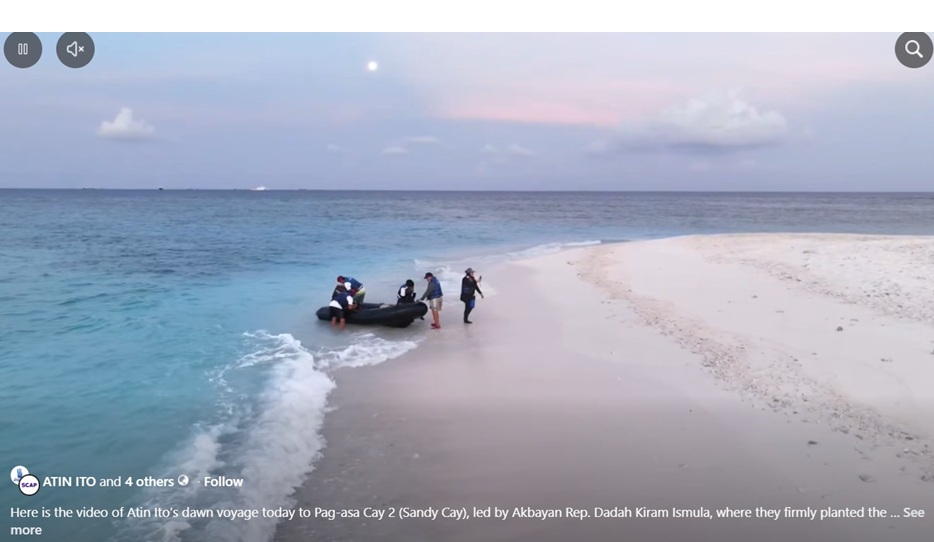
It was 5:30 AM on May 3, 2026, at the sheltered harbor of Pagasa Island. The team assembled by the Atin Ito coalition for the pre-dawn sortie to the Sandy Cay was making its final preparations. The three volunteers, who were formerly members of the Navy’s SEAL Team, have already prepped the rubber boat for use. Congresswoman Dadah Kiram Ismula and Matthew Silverio, both of Akbayan Partylist, were rigging the body camera onto their life preserver. Three other fast boats manned by troops based in Pagasa Island were also placed on stand-by, as a precaution.
Based on previous observations by the island’s Joint Task Unit, the Chinese Coast Guard vessel stationed near Sandy Cay takes about 15 minutes to deploy its rubber boats if they detect any boat movement from the island. The Atin Ito’s team has exactly 20 minutes to traverse the distance between the harbor entrance and the Pagasa Cay 2 (also known as Sandy Cay 1).
At 5:40 AM, the rubber boat was deployed. The coalition’s drone followed the rubber boat’s trail to document the mission on video. It had to fly just above the water to avoid the electronic interference prevalent at a higher altitude. Back at the makeshift command post at the harbor, Ms. Rafaela David, the mission commander, was intensely monitoring the situation through a mounted telescope.
Midway to Pagasa Cay 2, a lookout observed through the telescope a rigid-hull inflatable boat (RHIB) and two rubber boats being deployed from the nearby Chinese Coast Guard vessel numbered 5101. This information was immediately conveyed to Rafaela. The situation was tense at the command post and in the rubber boat itself. But surprisingly, the three Chinese boats did not give chase. The lookout reported that three boats stopped halfway between the CCG vessel and the Pagasa Cay 2, and maintained their station there.
In twenty minutes, the team reached the objective’s shoreline as planned. At 6:00 AM, Cong Dada and Matthew planted the Philippine flag and the Atin Ito banner as the sun rose from the horizon. It was living poetry in its execution. The team departed in just a few minutes and returned safely to the harbor by 6:30 AM. Cong Dada reported the mission’s details to the waiting local and foreign media. Rafaela, who was standing on the sidelines, sighed briefly and said: the mission was successful.
The pre-dawn insertion of a team at Sandy Cay was the highlight of Atin Ito’s 4th civilian mission in the West Philippine Sea. It required meticulous planning and coordination. The logistics suffered from several setbacks, but help from unexpected supporters made it still possible. In the initial planning, information was compartmentalized in case of undiscovered insider threats and an early discovery of the plan. To make it spy-proof, the jetski event was conceived as a decoy to distract Chinese observers and shift public attention towards another high-profile event.
The visit to Pagasa Island was the latest iteration of a series of missions. It began with the Christmas resupply run to Second Thomas Shoal in December of 2023, a similar run near Scarborough Shoal in May 2024, and a peace concert in the adjacent waters of Pagasa Island last May 2025. Each mission arc was part of a steep learning curve for the Atin Ito convenors and their courageous band of volunteers, as the next mission became more complex and challenging to execute.
However, the run-up to the last mission surprisingly revealed that there are limits to China’s use of its coercive power. When confronted by a resolute and dedicated challenger operating out of the box, it seems to have restrained itself. These observations were not easily discernible, but are nevertheless compelling snippets:
- Atin Ito’s flagship, the M/V Kapitan Felix Oca, departed Manila Bay for Pagasa Island without the usual PCG escort. It was met somewhere in Mindoro Island by a Chinese Coast Guard (3103) that came from Panatag Shoal. While it shadowed the Kapitan Felix Oca all the way to Pagasa Island from a distance of four nautical miles, at no point during the transit did it attempt to challenge by radio or to impede the vessel’s voyage.
- As Kaptain Felix Oca approached Pagasa Island at about 6:00 PM on May 2, 2026, it was met by two other CCG vessels, numbered 5101 and 5102. Altogether, the three CCG vessels were positioned near our vessel. A few minutes later, the silence at the ship’s bridge was defiled by a screeching voice coming from one of the CCG vessels issuing a radio challenge. Perhaps it was his way of expressing resistance, but Captain Jorge dela Cruz nonchalantly chose to ignore the radio challenge. The screeching voice still pierced the air, but without any getting a response from Kapitan Felix Oca, the Chinese officer on the radio began to sound pathetic.
- At around 12:50 PM on May 3, 2026, the coalition’s supply boat, M/L Chowee, was escorting the jetski from the vessel to the island. While in transit, a PLA- Navy Type 54 Jiangkai I-class frigate, numbered 525, maneuvered on a perpendicular course behind the M/L Chowee at a range of approximately 1000 yards. At the same time, a Z-9C Harbin helicopter hovered overhead, ostensibly flying overwatch. Despite the close call from the PLA-Navy vessel, at no point did it attempt to impede the movement of the supply boat or the jetski.
Looking back, one has to ask the question, were the four missions successful? Based it on the metrics that the coalition has approached China’s presence in our EEZ, it will have to be a resounding yes.
After four missions, Atin Ito has demonstrated that civil society has agency, and it has an equal stake in ensuring that our country’s maritime interests are defended at sea and in the public opinion space. Its strength lies in its “convening power,” manifested through its ability to harness the “people’s will to resist” and evoke the spirit of volunteerism among ordinary Filipinos.
Rafaela David’s concept of peaceful resistance, which she articulated after the 2nd mission, seemed to work. China has no viable doctrinal response to counter it either at the tactical or cognitive level. The audacity in which Atin Ito’s forays were carried out at Panatag Shoal and Pagasa Island, had exposed the limits of China’s hard power. When confronted with a resolute adversary, they can only watch or scream on radio.
Lastly, talk is cheap. We should have learned that lesson yesterday. Our verbosity alone will not drive China’s ships away from our exclusive economic zone. Words must be backed up by a coherent strategy and determined responses that imposes costs on them. Recovering control of our waters, after it was given up by the Duterte administration before, will require a long, arduous and incremental campaign, one island at a time, one feature at a time, one mission at a time.
*Rear Admiral Rommel Jude Ong (Ret.) is currently Professor of Praxis at Ateneo School of Government. An experienced naval officer specializing in strategic planning, operations, intelligence, and naval diplomacy, his last posting was as Vice Commander of the Philippine Navy until his compulsory retirement in September 2019.