For many Filipinos, Baguio remains mostly as an aspirational space of “rest and recreation” and theme park attractions, with strawberries and strawberry jams as de rigueur pasalubong.
In contrast, the peoples of the Cordilleras remain ever vigilant today in sustaining their identity rooted in ancestral land, community, and traditional knowledge as seen in a recent two-man exhibition titled Raised by Mountains by Leonard Aguinaldo and John Frank Sabado at Silverlens, Makati.
Encroachment
Leonardo Aguinaldo presents five large artworks, all mixed media on canvas layered with woodcut prints, correction tape, and acrylic products. Vertical structures dominate the mountains, complete with drop pin location symbols, obliterating the natural contours of the land. Adding collaged elements of his own prints reflects Aguinaldo’s deep sense of interaction with the Cordillera communities amidst rapid changes today.
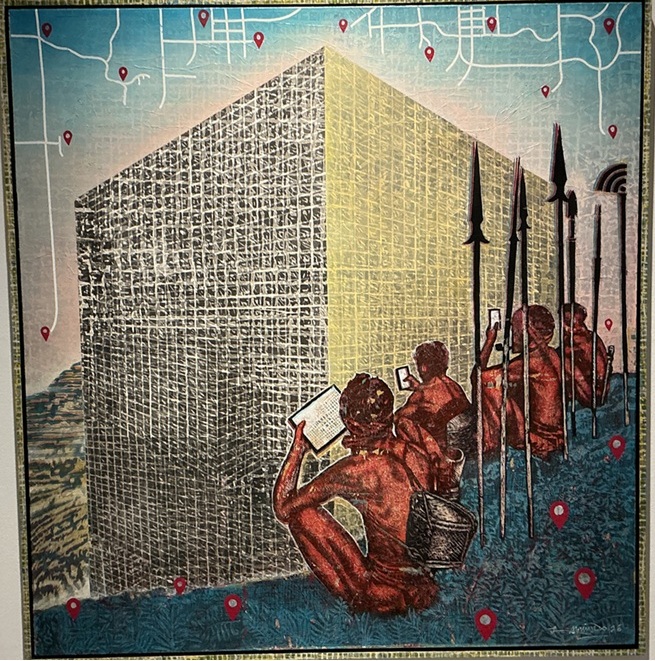
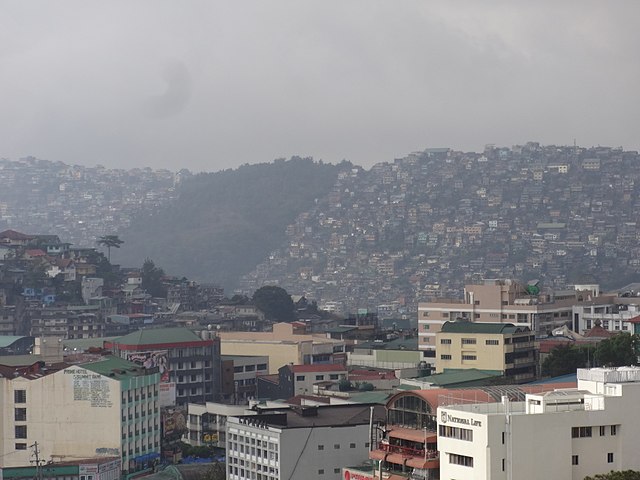
His work critiques the curse of development in Baguio as seen in the rampant rise of shopping malls and condominiums and their environmental impact: destruction of habitat and natural ecosystem and loss of biodiversity.
Referencing a colonial image of Igorots gazing at rice terraces, New Warriors on the Block (2026) depicts a group of Igorots huddled together in their traditional garb, tattoos, and baskets, seemingly busy and distracted with their tablets and smartphones. Besides them towers a massive structure denoting the encroachment of “modernity” in Baguio’s mountainous landscape. Supplantation (2026) and Miss Placing (2026) depict a similar imagery and theme.
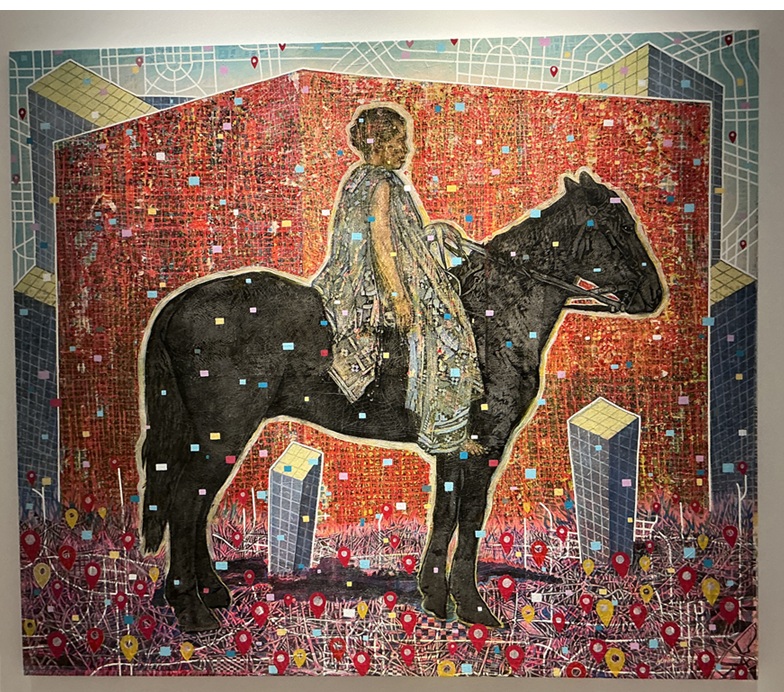
In This Place Meant Nothing (2026), a man on a horseback surveys the land from a high vantage point, right at the center of the canvas, with mountain trails nowhere in sight, again surrounded by concrete structures looming large in the horizon.
A construction boom continues unabated in the Summer Capital. Locals bear the price of development, an upheaval in the natural environment. Who gains? Who loses?
Bearers of knowledge
Sabado speaks of the power of family and community in his intricate pen-and-ink portraits that are richly layered with visual elements that pertain to the subject’s life and work.
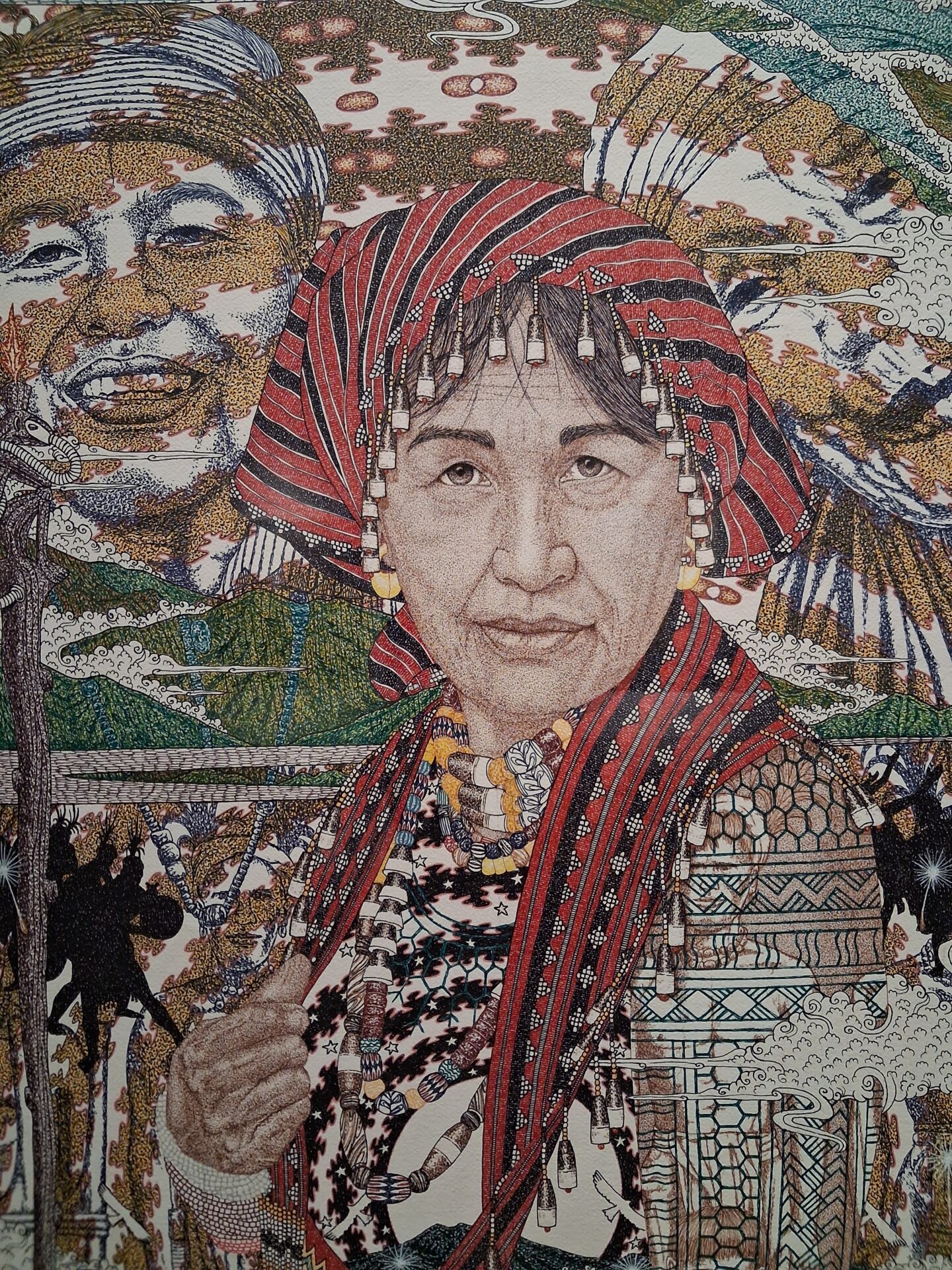
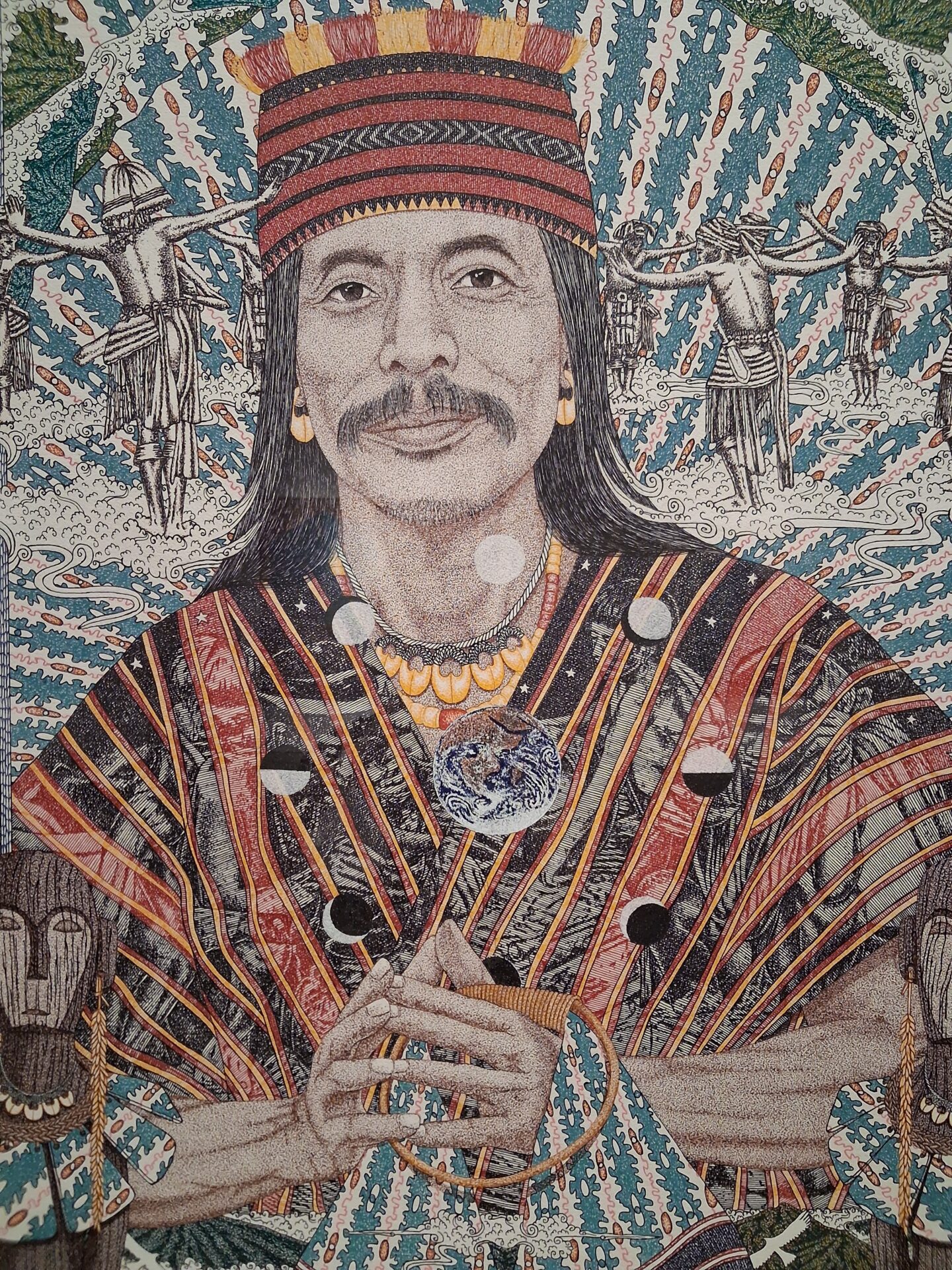
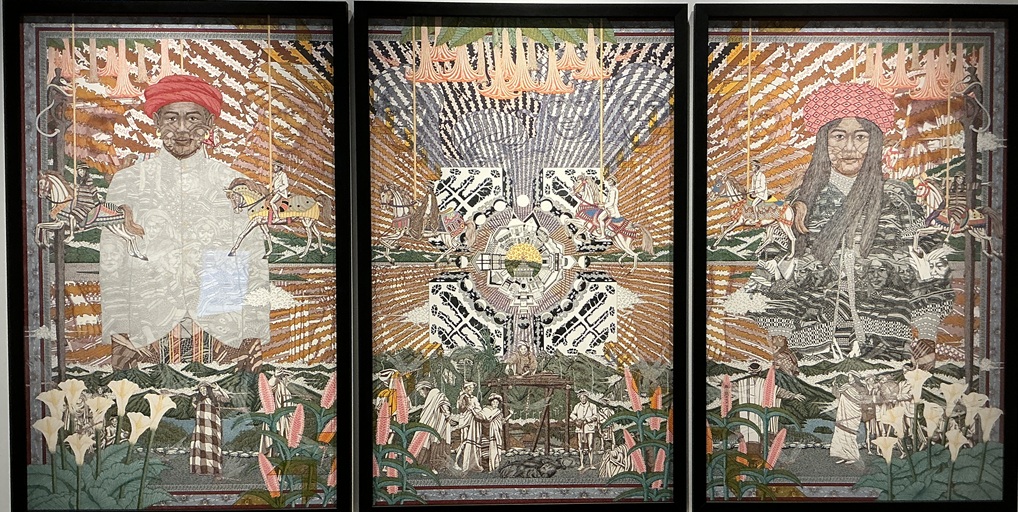
In portraits done in 2024, John Frank Sabado pays homage to six respected elders of the Cordilleras that include Kalinga women leaders whose lives reflect their dedication in sustaining cultural traditions; Vicky Macay (Madmad) a mambunong, a traditional priest in Benguet and a master of the madmad ritual that ask the spirits of the land and ancestors for blessings and guidance; Manang Jo, a filmmaker, with her portrait (Ina Pattikiw), and Mamerto Tindongan (Mumbaki), an eight-generation mumbaki or traditional priest, who has taught Sabado about Ifugao beliefs and spirituality.
Also included are Sabado’s mentors in two portraits (Lakay Magtibay and Lakay Bay-an), referring to artists Willie Magtibay and Roland Bay-an. Magtibay, known for his paintings on Ibaloi lifeways, was the one who introduced Sabado to the pen-and-ink medium.
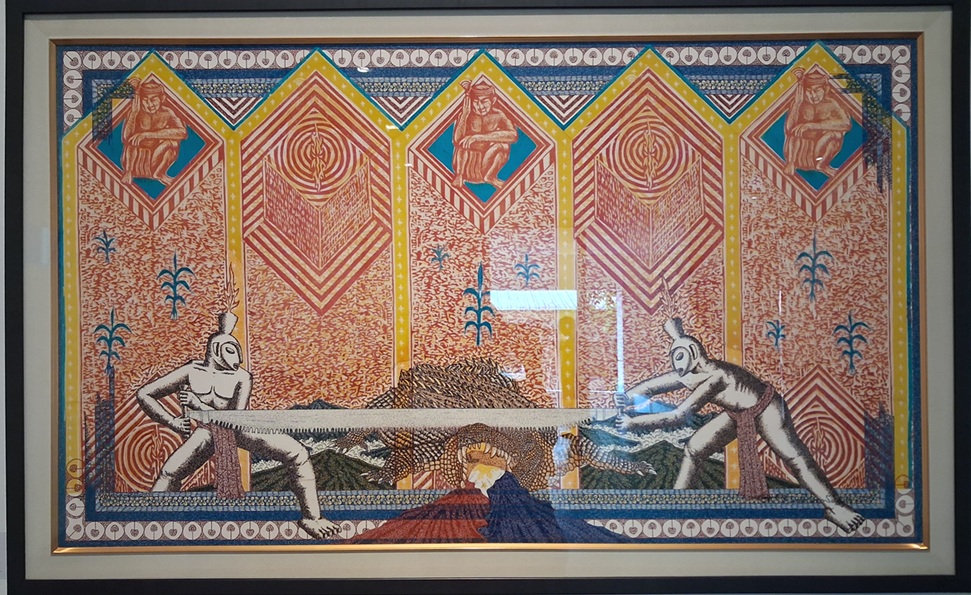
Twomansaw (2025) A pen-and-ink work by Sabado and Aguinaldo, the title is a play on “two-man show.” It depicts two bulol figures sawing off a giant crocodile’s head swallowing a Philippine flag, symbolic of systemic corruption that persists in the country. Aguinaldo explains that he added words of prayers in the background but in the process of carving them, they have disappeared.
In Sabado’s Premoradial Ancestors (2025), two figures are depicted, namely Mateo Cariño and his wife, Bayosa Ortega. Cariño was an Ibaloi chieftain who owned vast tracts of land that we now know as Baguio, including Camp John Hay. Defending his ancestral land against confiscation by the U.S. colonial government, he filed a suit in the United States. The U.S. Supreme Court through Justice Oliver Wendell Holmes ruled in his favor in 1909. It became later known as the Cariño Doctrine, the legal basis for the protection of indigenous rights over ancestral lands around the world.
Baguio artists
Both artists found their métier with the Baguio Arts Guild in 1991 where they started assisting and learning from artists like Santi Bose (1949-2002), Ben Cabrera (b.1942), and Roberto Villanueva (1942-1995).
Leonardo Aguinaldo (b. 1967, Baguio City): With his house on the side of a mountain overlooking La Trinidad Valley and Baguio City, he has witnessed the avalanche of new concrete constructions around his place. For over two decades, Aguinaldo’s works in print, rubber cut, and woodcut explore the changes in cultural practices and customs, reflecting his rootedness in his Cordillera homeland.
In 2004, he won the grand prize in the ASEAN Art Awards; he is a recipient of the Thirteen Artists Awards of the Cultural Center of the Philippines in 2003. He participated in the 2013 Singapore Art Fair as well as the Markets of Resistance project in Baguio in 2014.
John Frank Sabado (b. 1969, Mankayan, Benguet): A self-taught artist based in Baguio City and part of the Tam-awan Village Artist, his awards include the Thirteen Artists Award, CCP in 2000; Juror’s Choice, Philippine Art Awards, 2001. He was the Philippine Representative in Crossing Borders, Third Asia-Pacific Triennial of Contemporary Art in Australia, 1999.