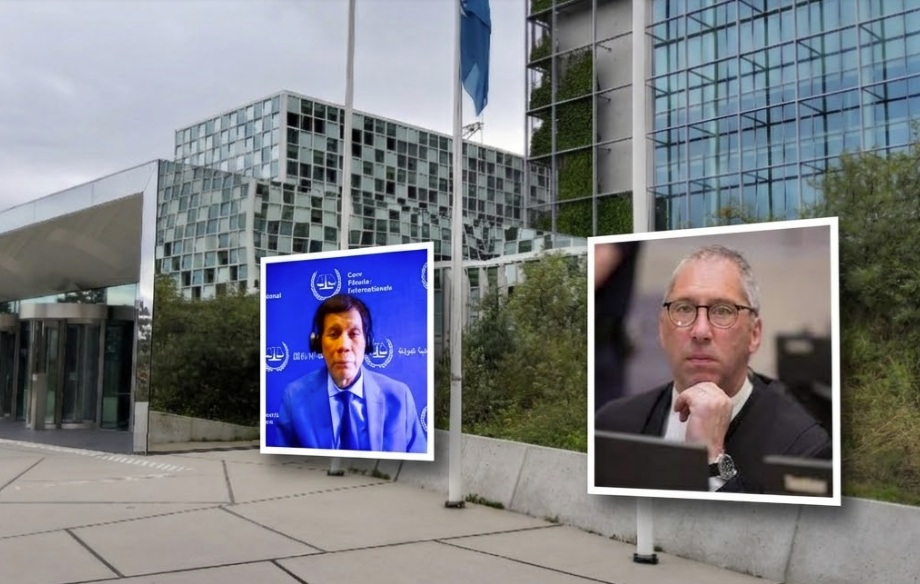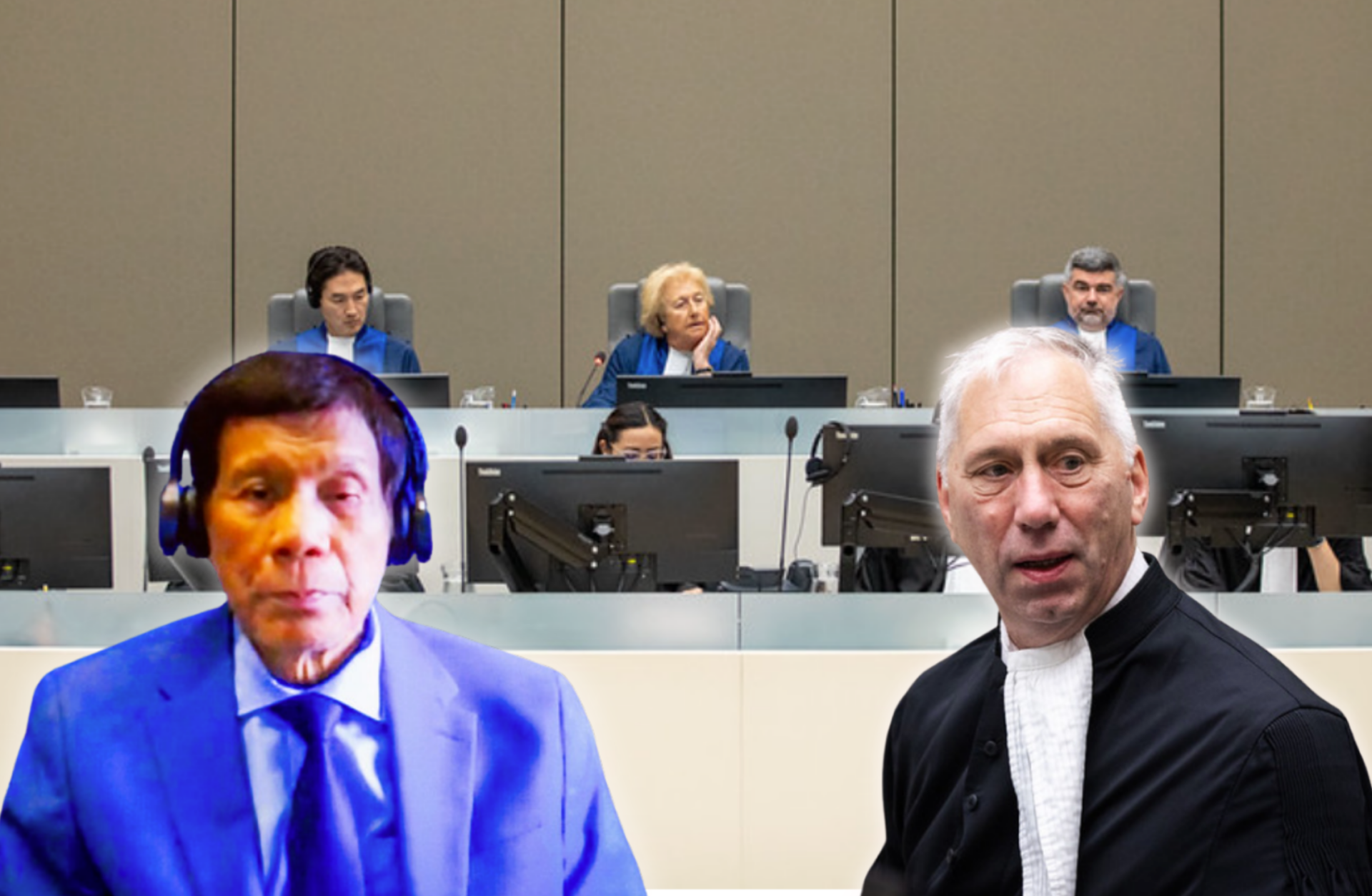
Former president Rodrigo Duterte’s defense team has requested the Trial Chamber III of the International Criminal Court to order the prosecution to refile the charges while complaining of the enormous volume of documents filed with the Court.
In his Aug. 31 filing, Peter Haynes, Duterte’s lead counsel, argued that the way the charges are currently framed violates Duterte’s “right to be informed in detail of the nature, cause and content of the charges.”
“Rather than containing a clear set of settled facts and circumstances supporting separate counts (being crimes under the ICC Statute), the document containing the charges (“DCC”) has been framed around illustrative non-exhaustive incidents, grouped under topical headings,” he said.
The prosecution, meanwhile, submitted on the same day its lists of witnesses and evidence for the trial. Both documents, however, were marked as confidential.
Additional items meant to “drown” defense?
Haynes also complained “the Prosecution had disclosed around 5,000 documents as at the date of the confirmation decision, which has now increased by over 400% to over 25,000 items at the date of writing, the Defence team has no chance of even reading this full volume of disclosure before the start of the trial.”
Haynes claims that many of the 20,000 additional items they received describe alleged killings which are unrelated to the listed incidents and suspects they “are simply being disclosed en masse to drown the Defence and obstruct its preparation.”
“The Prosecution’s decision to frame the charges in this entirely novel way makes it impossible for the defendant to know what case he has to meet at trial,” Haynes said.
Three counts, thousands of killings
Duterte is facing three counts of murder as crimes against humanity tied to his anti-illegal drugs campaign.
Count 1 encompasses the killings when he was Davao City mayor, Count 2 covers the killing of high-value targets when he was president, and Count 3 includes killings in barangay-level operations or known as Oplan Tokhang.
Haynes argued that a “count” under the ICC Statute refers to an individual crime. He said the counts in Duterte’s case, however, function more like “broad topical headings,” under which the prosecution would only need to prove one incident to secure a conviction.
“The accused is facing a trial in which he could be held individually criminally responsible for at least thousands of other murders, over a period of years, on the basis of one murder having been proven,” Hayes said.
“This cannot be reconciled with basic principles of individual criminal responsibility,” he added.
Defense seeks exhaustive list
He also questioned the prosecution’s use of a “nonexhaustive” and “illustrative” list of incidents, noting that even if the defense successfully raised doubts about all the incidents identified by the prosecution, the prosecutors could simply treat them as examples and rely on other evidence to prove killings that were not included in the list.
“The abnormal framing of the charges is a device to allow the Prosecution effectively to throw all its material at the wall and see what sticks, meaning that the accused’s statutory right to be informed in detail of the charges is being violated,” it added.
The only effective remedy, Hayes said, would be for the Prosecution to be ordered to re-file a set of charges that properly informs the accused of the case he needs to meet, with a defined scope and an exhaustive list of acts that constitute the case filed against him.
Trial set for November
Duterte has been detained at the ICC detention center in The Hague since he was transferred from the Philippines in March 2025.
The ICC’s Pre-Trial Chamber I confirmed all charges against him on April 23, allowing the case to proceed to trial.
The trial is scheduled to begin on Nov. 30 before Trial Chamber III.
The case stems from allegations that Duterte and others were responsible for killings committed as part of his campaign against illegal drugs. Duterte has repeatedly denied allegations of wrongdoing and has challenged the ICC’s jurisdiction over the Philippines after the country withdrew from the Rome Statute in 2019.